












Lt. Gen. Václav Vlček: Without Air Defense, We Cannot Protect Critical Infrastructure
Since 2022, our military has been undergoing a fundamental transformation and is returning to preparations for high-intensity conflict and the defense of NATO’s eastern flank. Lieutenant General Václav Vlček, Commander of the Operations Command of the Czech Army, speaks candidly in an interview with CZ DEFENCE about multi-domain operations, personnel shortages, the development of air defense, logistics, and why the army no longer trains for “fictional scenarios.” The interview also covers lessons learned from the war in Ukraine, the introduction of new technologies, and the Czech Army’s ability to respond to crisis situations in real time. General Vlček also describes how the role of the headquarters itself – as well as its cooperation with Alliance and civilian structures – has changed since 2022.
Video: Interview with Lt. Gen. Václav Vlček, Commander of the Czech Armed Forces Operations Command / CZ DEFENCE
General, in your opinion, how has the role of the Operations Command of the Czech Army changed since 2022 in terms of the actual command of forces and their readiness for deployment?
The Operations Command was established in 2020, and since 2022, this transformation has taken place on two levels. The first level is international, involving significantly greater cooperation with NATO’s command structure. In this case, as the Central Region, we are interested in NATO’s Joint Operations Command and our mutual cooperation – that is, cooperation in planning, sharing information, and jointly assessing the situation, as well as planning any response. That is level number one. Level number two, which intersects with the Operations Command, is this new dimension consisting of cooperation with other actors within the state. It will no longer be just the military addressing a specific crisis situation; rather, it will be a whole-of-state approach. For us, this primarily means cooperation with the departments of the Ministry of the Interior, the Police of the Czech Republic, the fire department, and, of course, the State Material Reserves Administration. These are the key players for us who will be essential to the overall defense of the territory of the Czech Republic.
Can this kind of collaboration be practiced?
It can be practiced. It’s not easy. In any case, the “Resilient Czech Republic 2025” exercise took place last year. And that is precisely the format that addresses the defense of the Czech Republic’s territory – not in isolation, but as part of a comprehensive approach and within the framework of NATO. This means we are simultaneously addressing three potential tasks that overlap. The first is fulfilling our obligations to NATO, specifically Article 5 – collective defense. Next is Host Nation Support, which involves supporting NATO forces on our territory. And the last area of cooperation is the defense of the Czech Republic’s territory as part of a nationwide approach – that is, cooperation within the “Resilient Czech Republic 2025” framework. We’ve had the opportunity to collaborate with both the police and the fire department, but we’re also trying to extend this to other ministries within the Czech Republic, because, for example, the issue of supporting units on our territory will also depend on other ministries being able to assist us. In this specific case, for instance, the Ministry of Health in terms of providing medical care. Another key area is the police. There will be a large number of tasks on our territory related to sabotage, subversion, and other offensive operations that will be launched and carried out as part of hybrid operations. This is primarily a task for the police, but we are exploring the boundaries of cooperation between the police and the military, and how to address these issues jointly.
However, the focus is on the Czech Armed Forces. How well-prepared are we, as an army, to conduct high-intensity combat and face a sophisticated enemy?
Lately, the word “capabilities” has been bandied about almost everywhere, regardless of what it actually means in reality. We need to look at the size of our army. This army has two brigade-level task forces, so we won’t be able to wage a large-scale war on our own. We’re part of NATO, so our brigades are integrated into divisions, and divisions into corps. And in this way, we create a large, combined force. If we picture this in real terms, a corps can have up to 100,000 soldiers. Now this probably fits into some larger structure. So we’re simply committed to having two brigade task forces ready to serve as full-fledged partners within a division and fulfill their mission. And this brings us to capabilities. It’s the capability of a brigade task force to fulfill its mission within a divisional structure. We are capable of fulfilling this mission. Do we practice this? Yes. The last exercise took place last year. It was the Amber Lionheart exercise, conducted in cooperation with the Polish side, specifically the Northeast Division. The goal of this exercise was to certify the headquarters of the 7th Brigade Task Force. And that went well. Yes, we have a problem in terms of manpower – hat is, filling the personnel positions we need. Yes, there is outdated equipment. But that still cannot detract from the fact that we must fulfill our mission.
And what about response capability? How quickly can the military respond – immediately, or within hours or days?
We adopted the so-called NATO Force Model. In 2025, we implemented this model within our armed forces. This was the task of the Operations Command in cooperation with our forces – the Air Force, the Army, the Territorial Forces, etc. So we adapted the model to our specific conditions. First, the capabilities of the individual components of this model; second, the response times, which are strictly defined; and third, the activation mechanism – how to activate the forces and move them to where they need to be. This is practiced regularly, and we are currently testing it at the battalion level, specifically in Slovakia, where the Slovakia Multinational Brigade is under Spanish command. Every year, the Strong Lineage exercise takes place there, where we test the mechanism for reinforcing this brigade with a single battalion – in real time. So, real-world activation, real-time movement, deployment, and the execution of tasks on the ground.
How does the Operations Command contribute to the achievement of NATO's alliance goals?
That role is unique. As I mentioned earlier, starting in 2022, we are implementing two major changes within this command. The first is very close, almost daily, cooperation with NATO’s Operational Command. That is the most important thing – that we are connected, we know each other, we know what the procedures are, and personnel from the Operations Command participate in the planning cycle for operations and exercises. For example, the Steadfast Deterrence exercise is currently underway, where members of the Operations Command are practicing certain scenarios together with other capabilities. That is the first aspect. The second aspect is cooperation with the civilian sector to ensure a nationwide, whole-of-government approach. This was a major unknown for us in the past, because our mission was crisis management – that is, primarily smaller-scale operations outside our territory – and we did not address the issue of high-intensity conflict. So this transformation lies in the fact that now it’s not just about what we send where and with whom we cooperate, but mainly about how we view the defense of our territory and how we perceive it.
That's a fairly complex transformation process. Just how difficult is it, actually, to change the direction of the military?
When we look at units in general, within our army we’re talking about brigade-level formations. Yes, they have a certain number of personnel; they aren’t large units. But when we look at NATO, we’re talking about corps, which are truly large units – 100,000 personnel. The primary focus is on training the staffs. The Operations Command staff is constantly undergoing some sort of transformation, and our task was to create a structure for the Operations Command that would be capable of conducting multi-domain operations. This is essentially a new direction within NATO. This means that in the past, when crisis management operations took place, the vast majority occurred in the land domain, partially supported by air power. But that was the extent of it. Now we know that a high-intensity conflict will unfold across all domains, including cyberspace and space. This means I have to train my staff to operate in all domains. Yes, we don’t have a maritime domain, but that doesn’t mean we don’t understand how it works. Above all, we must recognize that we will be part of larger units within NATO, and that a ship or naval forces can create an effect in the land domain by launching cruise missiles at specific targets, thereby enabling ground forces operations. My task is to gradually teach this to my staff. I always say that it takes three to five years from the start for the staff to become proficient in this. It depends on how much time we’re given and how many resources we have. But it’s not primarily about money; it’s about people. If people don’t understand the technology and the basic principles of multi-domain operations, it will never work.
But that requires staff stability. You need to have a stable team.
Of course, that won’t happen, because the rotation cycle within the military is three to four years. That happens here, too. But it always has to be done in such a way that not everyone leaves at the same time. Someone always stays behind, carries it forward, and maintains what I call “group consciousness and awareness” within the team. And then they pass it on to the next group. That’s the cycle. What’s essential for us is that the people who go to the Operations Command learn something and either move on to command positions at the tactical level or transfer to sections of the General Staff. So it’s a win-win situation for us, where we’re able to transfer our know-how to where we need it. They are our “ambassadors” who say: Operations Command knows how to do these things, and this is what they’ll expect from you.
If someone called you this afternoon to say they needed our military to be deployed, which capabilities do you consider to be truly fully operational today?
This is a difficult question to pin down, because in our country, tactical units are the ones that possess these capabilities. The highest-level unit is the brigade. And it depends on what exactly we’re asking. A brigade has a specific mission; it must be capable of planning an operation and conducting offensive, defensive, or containment operations, and so on. These are all capabilities by which we assess a unit’s ability to function. So if we’re asking about capability, we have to go back to the NATO Force Model, where we say: These units are at this level of readiness. We assess readiness based on unit certification. In our army, the NATO model applies to both ground and air forces, and we conduct evaluations of units’ combat readiness. So we know that we have a certain set of units that, as part of their combat readiness evaluation, have demonstrated specific capabilities and are deployable. It’s not about a single specific minor capability, but about the unit as a whole, which embodies that capability. We have units at various levels of readiness. There are very short response times, and that’s all about readiness and the ability to move somewhere. Our advantage is that we’re in the center of Europe, and our mission is essentially the eastern flank. When we look at the NATO Force Model and what is planned for the eastern flank, these are locations we can reach either by land, via roads, or by train. We are currently planning the “Resilient Czech Republic 2027” exercise, in which the scenario and the exercise itself will include a deployment to locations where those brigades would then actually operate.
I heard that the next drill will involve local residents. Is that true?
That’s probably not entirely true. The overall goal was to bring the exercise to the strategic level – that is, to the General Staff, the Ministry of Defense, and ultimately to other branches of the government. Above all, this concerns the main center of national defense command. We want this unit to conduct so-called staff exercises and determine what that actually entails. After all, if Article 5 were invoked and two brigade-level formations were to carry out their missions, deploying them would cost money. The state must respond to this. The Ministry of Finance must address this; there will be significant transit of other units, so, for example, the Ministry of Health must free up hospital capacity, and the Czech Police will have to clear roads, highways, and similar routes so that the convoys can pass through. And we’re trying to convey all these matters to other state agencies so that they’ll cooperate with us and understand their role in this process. It will no longer be just the army acting on its own, using the military police to transport twenty vehicles. Here, a thousand vehicles will be on the move – and that’s a completely different story.
Let's go back to Operations Headquarters. Where do you see the biggest gaps? Is it command, logistics, or fire support?
The Operations Command utilizes all of these capabilities. We know where the military stands because we conduct or participate in combat readiness assessments. The key now is to be able to use these capabilities to our advantage and understand each component. And this brings us back to multi-domain operations. I teach my staff that we will integrate these elements and synchronize them, both in the military and civilian sectors. And that is the greatest challenge. To achieve this, we must establish an information system in both the military and civilian sectors that is capable of integrating and cooperating with one another. A month ago, the FIE 26 exercise took place, one part of which focused specifically on cooperation with the civilian sector to enable them to connect. A new information system is being developed because even the military needs to know: the fire department is responding here, the police are deployed here, an operation is underway here, the military will be needed here, or we’ll need civilian resources here because we no longer have them in our own stockpiles.
Following the certification exercise conducted as part of the Multinational Division Northeast, in which our 7th Mechanized Brigade participated, does our army meet the required standards for interoperability, rapid movement, and deployment of units?
There are specific plans in place for this. We are covered by the Central Regional Plan. And as I’ve already said, our advantage is that we’re in the center of Europe, so the eastern flank is within our reach by road or train. Those brigades, battalions, and other components of the brigade formations are evaluated and have their certifications. Our biggest problem right now isn’t equipment, but manpower. This means that the main issue we always run into is under-staffing of units. For example, a unit may not have 90 or 100 percent of its personnel, but perhaps only 73 percent. The exercise you mentioned – the certification exercise developed by the Northeast Division for the 7th Brigade Task Force – was designed primarily to test the interoperability of the brigade headquarters. The division is not at all concerned with how our individual battalions operate, as long as they meet certain parameters. It is interested in how the brigade headquarters plans, shares information, and carries out tasks. For this to work, the systems must be interconnected. We have a national classified system; the Poles have their own system; and a requirement arose for a so-called “Mission Network” – a network designed for a specific mission, in this case for implementing the Central Regional Plan. We have an operational-tactical command and control system for ground forces, which we have integrated with the division’s system. We were able to share information with the Polish division, accept tasks, and conduct joint targeting – that is, sharing information about targets and methods of engaging them. This means creating a common operational picture. The division commander needs to see exactly how our brigade is doing, what kind of environment it is operating in, whether it is running low on forces and resources, whether it needs reinforcements, and so on. And we succeeded in all of that during the exercise.
With regard to the command and control system and the changes that have been taking place in recent years, how are these reflected in training and exercises?
This will be a major challenge for the future. We already have new technologies today, but as they say, even with cell phones, people use only about five, at most ten percent, of their capabilities – unless they’re real experts. And in the military, we’re in exactly the same boat. We have new communications vehicles, new communications equipment, new computers, and new command and control systems. But we have to teach people, first, to keep these systems up and running, and second, to make the most of their capabilities. And that won’t happen overnight. Everyone always thought that by introducing these systems, we’d be able to reduce our personnel numbers. But it will be exactly the opposite. Maintaining these systems will require more and more experts.
It is said that logistics is the foundation of a successful military operation. Our mission within the Alliance is called Host Nation Support. How well prepared are we, in practical terms, logistically for a high-intensity conflict?
Host Nation Support will primarily concern us in terms of troop transits and, if necessary, the deployment of units on our territory. We’ve essentially been through this every year. There are at least one or two major troop movements, primarily involving U.S. units. Sometimes these reach brigade strength, which is exactly what our mission entails: securing the movement of a single brigade at any given time. So we are capable of doing this. We have the forces and resources in place for this, and so far we haven’t encountered any problems. Very detailed planning is underway regarding their routes, where stops will be made, how to respond in the event of an accident or equipment failure, and so on. Another question, however, is how we fare in terms of logistics for sustaining units in overseas operations, specifically on the eastern flank, for example. In the past, we scaled back logistics significantly because we anticipated operations of lower intensity and smaller scale, where there would always be a national support element capable of establishing a supply chain for food, water, ammunition, and the like without major problems. Moreover, in those operations, the consumption of combat equipment and ammunition was not as high. All of that was significantly scaled back, and now we have to scale it back up again to meet the brigades’ needs. Specifically, this concerns national support elements and the third level of logistics. We simply do not have that capacity at present, and we will have to build it up.
Am I correct in understanding that the era of missions in Asia and Africa has come to an end and that we are now fully focused on NATO’s eastern flank?
That era is clearly over. I told our soldiers this several years ago – get ready for the fact that the future will involve deployments on the eastern flank and that the vast majority of the army will be on various types of standby. If we look at the situation today, we have small European Union operations – Bosnia and Herzegovina, the Irini and Aspides naval operations in the Mediterranean, and the MFO in the Sinai – but these are truly small-scale operations. The absolute focus today is on the eastern flank: Lithuania, Latvia, Slovakia, and Poland.
So when the soldiers are training, is it already in that direction?
Exactly. The change within NATO is that we will no longer be dealing with fictional scenarios. The days of inventing some fictional enemy and then building various incidents and situations around it are over. The current NATO leadership wants both individual countries and the Alliance as a whole to train based on real-world scenarios. It says clearly: you have the Central Regional Plan, so train according to what’s in the plan. If there’s a problem, adjust the plan or change the force structure. So it will no longer be playing soldier, but carrying out a specific mission. And it’s the same here. We’re integrated into the Central Regional Plan, and our Czech defense plan builds on it, addressing our territory and our commitments. Not fiction, but reality.
You mentioned that we are part of a force of approximately 100,000 soldiers. What capabilities should we quickly develop or expand so that we are able to defend our territory in a high-intensity conflict?
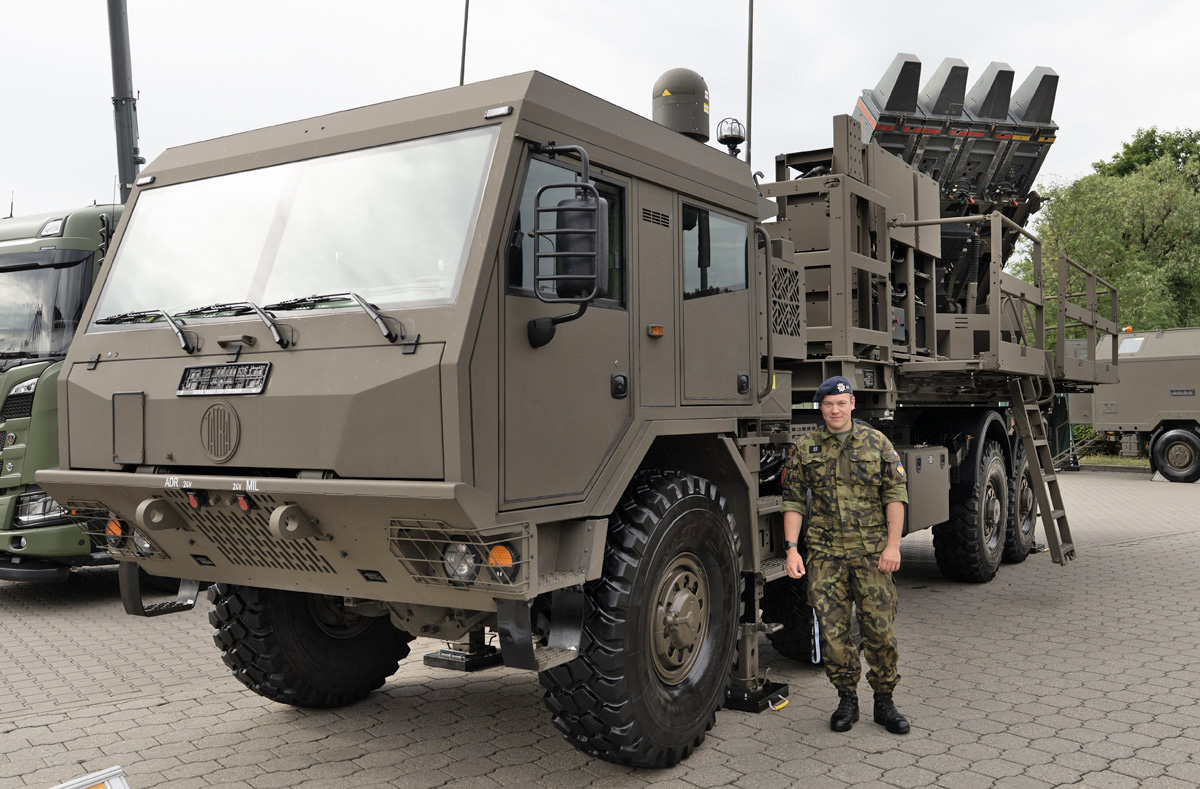
Nothing is likely to happen quickly. We need to be honest about that. The army is currently short about 7,000 soldiers and another 5,000 active reservists. Those are huge numbers. We expect that by improving service conditions and raising salaries, we’ll be able to boost the army’s reputation – a process that’s already starting to take effect. Plus, of course, the military’s efforts to maintain a media presence and inform the public about service opportunities. So the first and most crucial thing is personnel – soldiers and active reservists. Without that, we won’t make any progress. The next question is what to prioritize in our development. If we look at the Russia–Ukraine conflict, we have some guidance, but I don’t think a conflict between NATO and Russia would play out the same way. That would be something completely different. We must prepare to fight a high-tech adversary who, moreover, has gained vast experience from the current conflict. In my view, air defense is critical. When you look at how Russia is destroying critical infrastructure deep behind Ukraine’s lines, it’s a major warning for us. We cannot build our own air defense systems on our own. We’re purchasing SPYDER systems, which are excellent, but everything has its limits. We need to engage in broader alliance cooperation to ensure there’s a protective umbrella over Europe. The greatest risks today are missiles and ballistic missiles. Ukraine is demonstrating Russia’s ability to use these weapons, including hypersonic missiles. And Ukraine currently has virtually no defense against them. Frankly speaking, Europe is in a similar situation. So if anything is a top priority, it is precisely air defense and the protection of critical infrastructure.
The second priority is combating unmanned and unmanned aerial vehicles (UAVs), as well as autonomous systems in general. Today, even a tank can operate autonomously. It doesn’t even have to be a tank – it could be a small vehicle equipped with a few anti-tank missiles that can cause enormous damage on the battlefield.
And the third thing is the C4ISTAR system; today, people often even talk about C6 because of the cyber dimension. Modern systems will generate enormous amounts of data. We must be able to collect, filter, and analyze that data and provide the commander with clear information about the situation on the battlefield. Yes, everyone is talking about artificial intelligence these days. In my view, it’s not a silver bullet, but it dramatically speeds up the decision-making process. However, humans must remain part of the process. There must be a “man in the loop” – someone who knows what the desired outcome should be. But we’ve already seen that the speed at which information is delivered to commanders is enormous and will continue to increase. Working with data – filtering, integrating, and distributing it to the various levels of command – will be a massive challenge in the future.
I have to say that, after all these years, the fantasy that everything will be electronic and unmanned – and that we won’t need tanks or infantry fighting vehicles – is coming back like a boomerang. What will the composition of the army look like in the near future?
It’s probably about the fact that unmanned and crewless systems won’t be a panacea, but we have to factor them into our plans for the future. When I was at an industry event, I recalled a report from the time when the Russians were operating in Syria. Back then, they reportedly managed to integrate unmanned aerial and ground systems to carry out an attack on a specific location. That caught my attention at the time as an early sign of things to come. Today, something similar is unfolding on Ukrainian territory, once again initiated by the Russian side. But the Ukrainians are also using these systems. It won’t be a silver bullet, but looking ahead, I can envision a mechanized battalion comprising three standard companies – whether equipped with CV90s or Pandurs – and one company of unmanned ground vehicles (UGVs). It doesn’t have to be anything large. These could be support assets that the battalion commander deploys as sensors or for reconnaissance. This conserves his own forces, gathers intelligence, and can partially neutralize the enemy, since these systems can carry UAVs, rockets, machine guns, or other weapons. There has been tremendous progress today, and this future is not far off. I believe that even today’s conventional mechanized battalions will have one or two companies dedicated to unmanned systems in order to conserve their own manpower.
| CZ DEFENCE
You mentioned that the conflict in Ukraine would not unfold in the same way if Russia were to come into conflict with the rest of Europe. Is the conflict in Ukraine still a source of information and lessons for changes in military training and procedures?
I don’t think it’s entirely about training. There are a lot of articles saying that we need to brush up on trench warfare and the like. But I say that the nature of war – at least in its early stages, if one were to break out – would certainly not be fought in trenches. It would be maneuver warfare, just as it should be. Large mechanized units would be pitted against each other. We don’t see that right now on NATO’s eastern flank or in the conflict between Russia and Ukraine. There, it often involves small units – a company, a platoon, a squad – that gradually try to break through the front line and occupy small areas. In my opinion, it certainly wouldn’t work that way. If we’re learning anything from Ukraine, it’s primarily about survival. This means that even units advancing forward must not be destroyed before they reach their designated area or battlefield. In addition to air defense, coordination across domains and the synchronization of effects are crucial. This means I can employ air, ground, naval, or other assets for a specific operation. So I see the main lessons in two areas: force protection, and new information systems – targeting and command and control systems. In my view, these are the two main areas we must focus on in terms of the army’s further development.
From the perspective of the Operations and Cooperation Command, where should we, as an army, step up our efforts in terms of technology or military capabilities in relation to the rest of the Alliance? What areas do we need to catch up on?
I think that today, all of Europe is playing catch-up. Everyone has focused on crisis management and small-scale operations, and has significantly scaled back its capabilities in every respect. There used to be highly specialized units that were deployed whenever needed, and everything was fine.
In my view, the most crucial factor for our military – as well as for the entire West – will be the way we procure military equipment and services. I believe the current model is outdated and completely inadequate. If you look at the pace of change and modernization of technology in Ukraine – specifically, for example, UAVs, their software, methods of use, and the discovery of new capabilities – it simply cannot take three years. Our standard process – where we write a specification, put it out to bid, receive something in three years, then conduct field trials, and finally have it in the army’s hands in five years – is simply unsustainable. If we continue this cycle, we’ll get nowhere. An innovation hub must be created. It must include universities, experts, companies with the necessary know-how, and our military. These entities must collaborate. What they develop must be tested at military training ranges, adjusted to meet the required parameters, and immediately deployed to the military. If we don’t implement this, we’ll always be lagging behind.