















Food in Combat Conditions: How Modern Military Rations Work
A great deal of information about combat rations, also known as MREs (Meals, Ready-to-Eat), can be found online. However, most of the available reviews focus primarily on the taste of individual meals. Yet behind a modern combat ration lies extensive materials engineering and a sophisticated physicochemical system. The main criterion in its development is not the gastronomic experience, but the ability to preserve food in an edible state for a long time, even under extreme climatic conditions, while also allowing it to be heated without the use of an open flame.
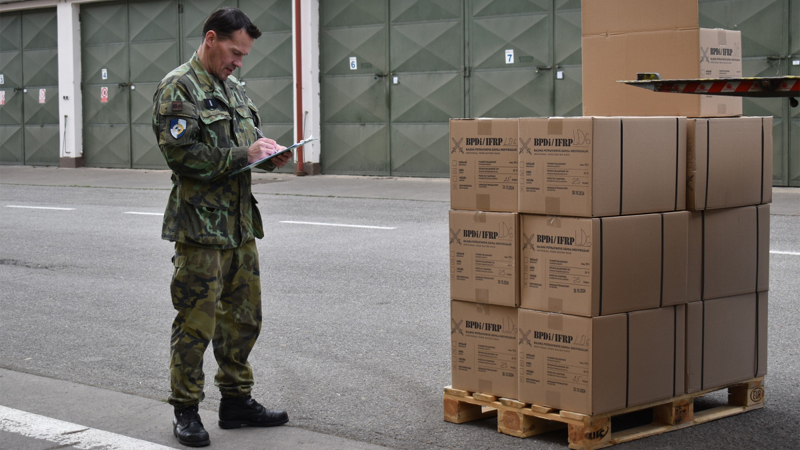
The Czech Armed Forces have not lagged behind in this regard either. The development of Czech combat rations dates back to the era of the Czechoslovak People’s Army, when heavy canned rations (KD) were used. Through gradual technological advancements, the system has evolved into the current individually packaged food rations (BPDI), which meet NATO standards.
Traditional tin cans were gradually phased out primarily due to their physical limitations. The cylindrical shape of the cans creates approximately 21.5% of unused space during palletization, and the metal packaging itself significantly increases the total weight of the transported material. The cardboard packaging used later also had certain limitations. The retort pouch has therefore become the modern solution, offering significantly lower weight, better stackability, and more efficient use of transport space.
At the same time, the flat shape of the retort pouch maximizes the surface-to-volume ratio, which significantly accelerates heat transfer during thermosterilization. Thanks to the shorter heat treatment time, food is exposed to high temperatures for a substantially shorter period, thereby limiting the degradation of vitamins, amino acids, and other nutritionally important substances.
The retort pouch consists of several functional layers. The outer layer is made of polyester, which protects the pouch from mechanical damage, such as abrasion or tearing. This is especially important when carrying equipment under demanding tactical conditions. Beneath it is an aluminum foil layer that acts as an effective barrier against the penetration of oxygen, water vapor, and light, thereby significantly extending the shelf life of the stored food. The inner layer is made of polypropylene, which comes into direct contact with the food. This material withstands high temperatures during thermosterilization, allows for an airtight seal of the contents, and simultaneously meets the requirements for safe contact with food.
An equally important aspect of modern combat rations is the method of heating meals. Traditional heating with solid fuel, which was the standard for the Czech Armed Forces for many years, is now an outdated solution for the modern battlefield. In addition to the need to carry a separate stove, an open flame poses a significant tactical risk. One solid alcohol tablet burns for approximately ten minutes, which is sufficient to heat canned rations. However, such a long burn time significantly increases the likelihood of a soldier being detected on a modern battlefield equipped with thermal imaging devices.
For this reason, chemical food heaters are being used more and more frequently today. Their main advantage is that they do not require an open flame, thereby significantly reducing the risk of both visual and thermal detection. The principle behind its operation is simple – the food is placed in a special heating pouch, a small amount of water is added, and the food is heated within a few minutes.
The operation of a chemical food warmer is based on an exothermic chemical reaction. In simple terms, it can be compared to a very rapid corrosion process. Ordinary iron corrodes slowly in a moist environment, and this reaction releases a small amount of heat. In chemical heaters, however, magnesium—supplemented with fine iron particles—plays the main role. When water is added, a galvanic cell is formed, which significantly accelerates the oxidation of magnesium. The energy that would be released very slowly under normal conditions is converted within a few minutes into a sufficient amount of heat capable of warming food to a serving temperature.
Logistics is also a significant aspect of modern combat rations. A key requirement is long-term shelf life, which is significantly influenced by ambient temperature. The Arrhenius equation, which describes how the rate of chemical reactions depends on temperature, is used to model the effect of temperature on degradation processes. In practical terms, this means that at low temperatures, food can last up to five years without significant loss of quality, whereas when deployed in hot climates – such as during Czech Armed Forces missions in Mali – the contents degrade much more rapidly, even though the packaging remains intact. As a rough guide, every 10 °C increase in temperature, generally accelerates degradation processes by approximately two to three times. Therefore, during long-term storage above 40 °C, the shelf life of a ration can be reduced from several years to just a few months.
A fundamental pillar of combat ration logistics is also their compatibility within NATO. This is ensured by the STANAG 2937 and STANAG 2556 Standardization Agreements, which define the requirements for the design, labeling, and use of these rations. Although Czech BPDIs comply with Alliance standards, minor shortcomings can still be found. One such issue, for example, is that information on the required amount of drinking water is not available to the user without unpacking the ration itself.
The latest generation of Czech individually packaged food rations also represents a significant advance in terms of modularity. The full-day ration is divided into three separate packages that can be easily distributed throughout a soldier’s gear. The system is based on six variants labeled 1 through 6, which can be combined to create up to 125 different meal plans. Supplementary packages PP-C and PP-D are intended for soldiers with increased energy expenditure, while specialized variants P Air and P Par are designed for members of airborne units.
Today, a soldier’s nutrition is no longer merely a matter for chefs and nutrition specialists. Materials engineers, chemists, and technologists play a significant role in the development of combat rations, optimizing the properties of packaging materials, preservation processes, and the energy value of individual meals. Every soldier who carries an individually packaged food ration in their gear today is also carrying the results of advanced technological development. This ensures sufficient energy intake even under the most demanding conditions, without significantly increasing the risk of revealing their position while preparing a meal.