












Hynek Kmoníček: The Biggest Threat Is Believing That Everything Will Stay the Same
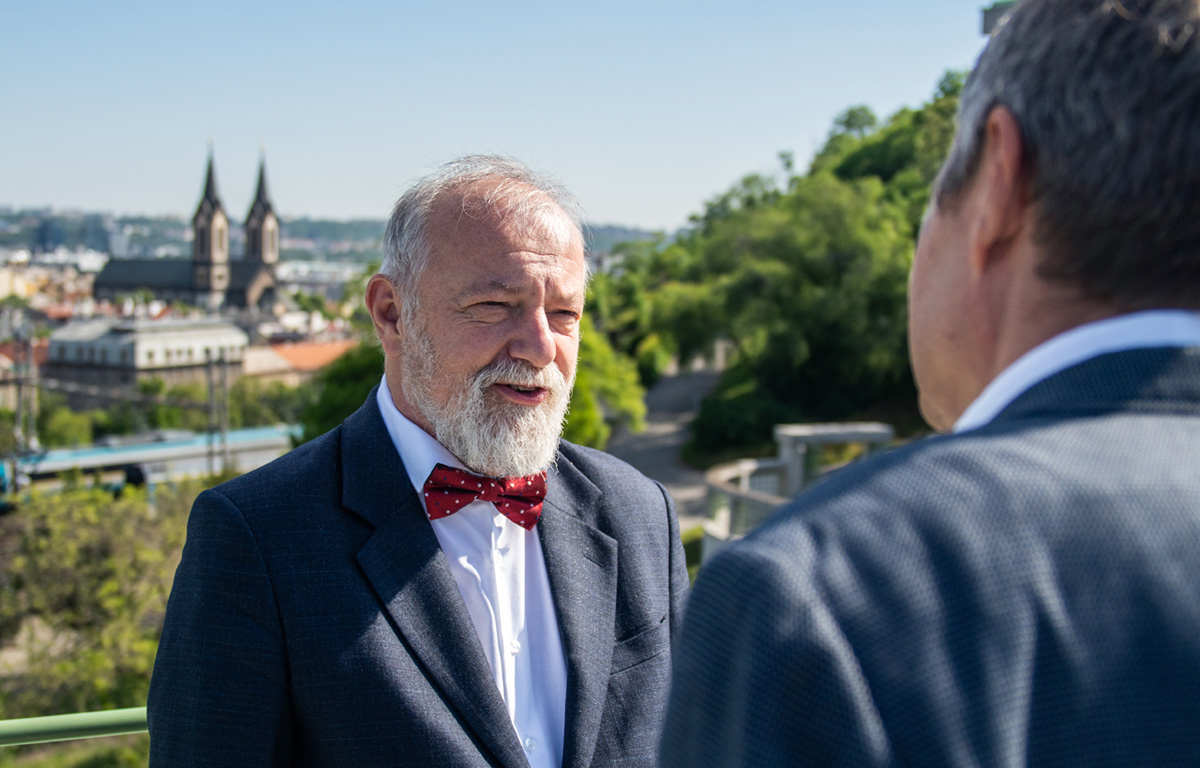
According to Hynek Kmoníček, the Prime Minister’s Advisor on National Security, the security of the Czech Republic does not depend solely on current conflicts, but above all on the state’s ability to correctly interpret long-term geopolitical changes. In the next episode of the CZ DEFENCE podcast, Kmoníček discusses the changing security environment, the future of European defense, the relationship between NATO and the European Union, the need to modernize crisis legislation, and why he considers a false sense of security to be one of the greatest threats.
Video: Hynek Kmoníček: The Biggest Threat Is Believing That Everything Will Stay the Same / CZ DEFENCE
When Hynek Kmoníček spoke at the conference “Our Security Cannot Be Taken for Granted” shortly after taking office, he highlighted the rapidly changing security environment. According to him, this trend has only intensified since then. “The security situation of every state is a combination of external influences – which are constantly changing today – and the state’s internal preparedness. It changes every day, yet at the same time it has remained the same for centuries, because geopolitics creates the fundamental framework within which a state operates. Your greatest friends and greatest risks are always found in your immediate vicinity. In this respect, the security situation of the Czech Republic is not very different from that of the Přemyslid Kingdom.” It is precisely this long-term geopolitical perspective that is one of the defining features of Kmoníček’s thinking. According to him, security cannot be assessed solely through the lens of the last few years or individual crises.
The public often associates the role of the Prime Minister’s Advisor on National Security with the image of someone who makes decisions on key security issues. Kmoníček, however, describes his role differently. “Essentially, I’m a conduit, a translator between the highly specialized security community and politicians,” he explains. “The security community uses its own language and jargon. Politicians need to have things explained to them in a way they can understand and so they can see the connections, for example, to their responsibilities or public image. At the same time, it involves coordination among individual agencies, which often overlap or even compete with one another,” says the Prime Minister’s advisor. He identifies coordination among ministries as one of the most difficult parts of his job. According to him, the Czech environment still suffers from strong departmentalism. “It’s largely therapeutic work,” says Hynek Kmoníček with a touch of hyperbole. “You have to reconcile various egos, which are sometimes larger than the weight of their institutions warrants, so that in the end everyone benefits.” At the same time, he rejects comparisons with his predecessor, Tomáš Pojar. “From the start, I haven’t been fulfilling Tomáš Pojar’s role, but rather that of a national security adviser, who advises rather than leads,” he emphasizes. He points out that every prime minister needs a different type of adviser and that the current form of this position corresponds to the prime minister’s working style.
According to him, a major advantage of Kmoníček’s current role is his many years of experience in diplomacy. In his own words, without that experience, it would be practically impossible to do this job. “I’m in contact with most security advisors in Europe, as well as in the United States, Africa, and Asia. The difference between diplomacy and security policy is practically nonexistent. Every diplomat must be a negotiator, a marketer, and someone who understands security issues,” he explains. His experience working in the United States and Vietnam, he says, confirms that security is always part of diplomatic work; only its importance varies depending on the specific country. Yet he does not consider any specific country or conflict to be one of the greatest threats of our time. “The greatest threat is the notion that everything will remain the same as it is today,” Hynek Kmoníček states unequivocally. “We live in one of the safest societies in the world and take it for granted. We’re relatively pampered; we try to ignore the world around us, but it keeps reminding us of its presence. The greatest risk is the feeling of absolute safety and the conviction that it’s always been this way and will always be this way.” According to him, this isn’t a failure of any specific government. “It’s a natural psychological process. Since World War II, we haven’t experienced an open military conflict. Everything happened far away. People have grown accustomed to the state handling security. More important than scaring the public is providing general education about the world we actually live in today.”
He identifies the gradual shift of the global center of economic and political power from the Euro-Atlantic region to Asia as a fundamental change. “This is the Asian century,” he states. “Europe has achieved an exceptional standard of living and built a welfare state in part because, for many decades, it did not have to bear the main costs of its own defense. That era is coming to an end. Yet we have remained a hundred years behind, both emotionally and intellectually.” According to him, it is precisely the experiences from Asia that allow us to see Europe from a different angle. “We still think of Asia as exotic. In reality, we are the exotic ones. Europe today accounts for approximately 16 percent of global GDP, and our thinking about the world must reflect that.” According to him, one of the most important security issues in the coming years will be the transformation of European defense. “Europe will have to increase its defense capabilities because the United States will no longer be willing to bear the main costs of European defense. At the same time, however, we must build European capabilities in such a way that they do not compete with NATO, but rather serve as a natural complement to it.” Kmoníček points out that just a few years ago, the United States tended to reject European strategic autonomy. “Today, the geopolitical situation has changed. European strategic autonomy is an unambiguous requirement for the future and will also be supported by the United States. The hardest part will not be creating it, but ensuring that it functions symbiotically with NATO.” He also speaks very openly about the future of the European Union. “One of the biggest questions for the next twenty or thirty years is: Are we building a federal state or a union of nation-states? Europe’s problem is that we are building both at the same time. On Monday and Tuesday we’re building a federal Europe; by Wednesday the news gets out; on Thursday and Friday we’re demonstrating against it; and next week we start all over again.” Nevertheless, he does not rule out that defense itself could become one of the integrating elements of the future Europe. “A European army could be one of the first truly unifying projects.
Politically, it’s very complicated, but the military operates on orders.” He also considers migration pressure to be one of the future driving forces. “Take Lagos, for example. By 2050, it could have seventy million residents. Where do you think people will go if they can’t make a living there? Europe won’t be able to function in the long term if it can’t protect its external borders.”
He also devotes considerable attention to the Czech Republic’s preparedness for crisis situations. In his view, it is essential to fundamentally modernize the legal framework for crisis management. “At best, our legislation dates back seventy-five to ninety years. Today’s threats and technologies are completely different. The way wars are waged, military technology, and strategic thinking are all changing. Our legislation must keep pace with these changes.” Nevertheless, he once again sees his role primarily in coordination. “Now that everyone knows what needs to be changed, we must not start squabbling over who should do it. That is precisely where my role lies.” When asked about disinformation, he responds with far greater sobriety than is typical in the current debate. “Propaganda has always existed. We’ve just started paying more attention to it. Anyone who thinks they’ve already mastered the issue of hybrid threats will ultimately end up as a censor. That’s why I’d be very cautious.” In his view, open public debate is the most important thing. “If I have an opinion, I must be able to defend it with logical arguments. Today, two emotions based on incomplete information often clash. And you can’t refute emotion with reason. And that is precisely why public discussion today is so contentious – everyone accuses everyone else of everything, yet they seem to be avoiding the old rule we used to have in the Middle East, which said: the less you know about something, the more firmly you hold your opinion on it,” adds Kmoníček.
He points to cooperation between the civilian and military sectors as an area that is gradually improving. “To put it diplomatically, I’d say it’s evolving. Both sides would claim it’s good, yet at the same time they could cite a number of examples where it didn’t work. But the answer always lies in communication and cooperation,” says Hynek Kmoníček. He takes an equally pragmatic view of the question of which ministry is most important from a security perspective. “Today’s problems are so complex that no single ministry can be the key player on its own. What matters most are the people who have a long-term understanding of the issues. After that, it hardly matters which institution they represent.” In his view, security cannot be separated from the economy. “Without economic stability, you have no security. As soon as security deteriorates, the economy suffers. And when a country begins to grow poorer, its security immediately deteriorates as well,” says Hynek Kmoníček in the interview. In his view, the Czech Republic should primarily develop cooperation with countries to which it can offer specific capabilities.
If you’d like to learn more, watch the full interview at the beginning of this article.