











Maj. Gen. Petr Svoboda: The Individual Is Important, but Team Czech Republic Matters More
The Territorial Forces of the Czech Armed Forces are undergoing a restructuring process that responds not only to changes in the security environment but also to NATO’s renewed emphasis on collective defense and deterrence. Their role, however, extends far beyond territorial defense battalions and the active reserve. It includes the exercise of state administration, the protection of facilities vital to national defense and critical infrastructure, support for allied forces on the territory of the Czech Republic, and cooperation with regional authorities, the integrated rescue system, and the civilian sector. We spoke with Major General Petr Svoboda, commander of the Czech Armed Forces’ Territorial Forces, on the CZ DEFENCE podcast about building the Territorial Forces, experiences from Poland and other NATO countries, the active reserve, lessons from the war in Ukraine, voluntary military training, and the need for greater resilience across society.
Video: Genmjr. Petr Svoboda: Jedinec je důležitý, ale tým republika je víc / CZ DEFENCE
General, you have served within NATO for many years. In your view, how has the Alliance’s approach to collective defense changed over the past three years, and how are these changes reflected in the Czech Armed Forces?
It’s been a major topic in the media. All military leaders at the strategic level say that NATO has returned to that first “D” – deterrence. That’s the trend. Our role, of course, is to build up our capabilities and have troops and units ready for collective defense. To put it simply, the goal is for NATO to be able to rattle its sabers on the Alliance’s periphery so that no one dares to challenge us and so that the conflict never starts in the first place – which is the best-case scenario. People won’t die, and we’ll show that we’re strong enough that, in a way, they’ll be afraid to threaten us. In this context, the change is, of course, significant, because all plans and exercises have begun to be conducted according to regional plans. This means that all factual elements are taken into account; we’re no longer relying on unrealistic scenarios.
And this is exactly what we’ve just started doing in Poland. That was my last posting, where we prepared training exercises for NATO forces. We tried to incorporate the territorial forces of Poland – and, of course, those of the Baltic states and other countries – into these exercises, depending on the region where the training was being organized. That means Hungary, Romania, and so on; there are several such scenarios. That’s where we gained the experience that the army command likely drew upon today when it put me in charge of the territorial forces. At least, I hope that’s the case. I don’t really believe in coincidences. Now I have an endless array of possibilities for what I can change and what I can influence—within the constraints of the strategic level, of course.
If we look at the list of tasks awaiting the territorial forces, what’s in the top half? What tasks must the territorial forces begin to carry out now? Perhaps it’s still partly about their development.
Actually, it’s still about development, in accordance with the concept, of course. We’re still in the first phase, which means we’re preparing everything. Of course, the concept was developed over a certain period of time, and since then the urgency has increased somewhat. This means that the implementation of the concept is also accelerating somewhat. If we are able to speed things up – whether in terms of personnel, materials, or even locations, such as when we are searching for suitable facilities – we naturally do so in cooperation with elements of the General Staff’s Capability Planning Section or the Ministry of Defense.
But let me return to those three areas. The first important area is the administration of state affairs with regard to defense laws, the Act on Professional Soldiers, and so on. This refers to the primary tasks of the Regional Military Administration (KVV), which include registration, recruitment, the reserves, and all related administrative procedures. The second aspect is the more “combat-oriented” part. This refers to the territorial defense battalions, which are stationed within the regions where we recruit active reservists. In peacetime strength, about 90 percent of our active reserves are stationed there. We’re working to recruit, train, and prepare them, and to assess the areas for which they’ll be responsible, taking into account the terrain and its capabilities. This ensures that any characteristics we find there are incorporated into our plans. So this is the area of internal security and defense. And then there is another area that we took over this summer and on which we are working hard. This is Host Nation Support (HNS), or rather, support for deployable forces. We must provide security for NATO forces on our territory as they move from one part of Europe to another – north, south, east, or west – and assist them when they need training, for example.
And it’s not just the military aspect. Since they’ll be here for some time, we have to help coordinate all the elements in the region – civilian companies, contractors, regional crisis management, and so on. I’m not saying soldiers will do all of this, but we’re showing how it could work. And we have to coordinate with crisis management so that we’re not working against each other, but acting in unison.
So is the main task of the territorial forces to provide Host Nation Support and coordinate, let’s say, government administration?
It’s one of the main tasks. We soldiers won’t be coordinating all civilian areas in peacetime; our task is to coordinate the security of the deployment, movement, and any replenishment of fuel, water, etc., for allied forces so that the entire operation has as little impact as possible on the region’s daily life. There will certainly be larger-scale security operations as well, during which we’ll ask the population for their patience and willingness to adapt to short-term restrictions. In peacetime, the army and territorial forces will always serve in a supporting role. It’s important to realize this, because peacetime is different from a state of war or a state of national emergency.
There’s a lot of talk about societal resilience. How does the work of territorial forces relate to this concept?
Very significantly, because I would say that we are among those who are truly closely connected to society. Since we are present in every region – we have a unit in every region – and we fulfill the administrative duties arising from the Defense Act and all these matters, we are actually in constant contact with the people. I just hope that my vision will come true – that the active reserves of the Territorial Forces will consist of people who know everything about that particular territory and will help us ensure internal security and protect areas vital to national defense and critical infrastructure.
You mentioned the regional military commands. Is there a deadline by which all regional military commands must fulfill the tasks you will assign to them? Or are you ahead of schedule in some areas and playing catch-up in others?
It’s important to note that while it might seem that way to the layperson, the regional military commands are actually “ready.” The regional military commands are fulfilling their roles. Of course, we can discuss whether to add personnel in one place, reduce them elsewhere, or reassign someone to a different location. But the administration is running smoothly. There are nuances – for example, a lawyer might find a poorly worded sentence in a law or a sentence in a law that’s been misunderstood. That’s all part of a “never-ending story.” Of course, findings from real-world experience must be translated into requests for changes, or we simply have to adjust our procedures. But the regional military commands are here and fulfilling their mission.
Now we must turn to the territorial defense battalions. There used to be companies here; now battalions have been formed. Of course, the battalions aren’t fully staffed yet. We’ll try to staff them as quickly as possible and train them together, because right now they can’t function without each other.
I am currently preparing a defense plan, which is classified, so I can’t say much about it. The task, of course, is to jointly prepare plans for securing facilities critical to national defense or critical infrastructure in a given region. Each region has different needs, and we will adapt the structure accordingly. All of this will, of course, be in coordination with the crisis management teams of the regions, the ORPs, and other “comrades-in-arms” in ensuring internal security – that is, the police, municipal police, firefighters, and the Integrated Rescue System (IZS). All of these actors will, of course, be operating in that territory.
When we talk about societal resilience, it’s also necessary for the public to understand how the military operates – for example, through exercises and various events taking place across the Czech Republic. To what extent do you plan to make these events more visible to the public in the future, so that the majority of the population has a chance to get up close and personal with soldiers?
I would disagree somewhat, because the Territorial Forces and territorial defense battalions generally train outdoors. We always coordinate our exercises at critical infrastructure sites. Most recently, we trained in Břeclav near a pumping station, so people can see us there. And it’s precisely that interaction with firefighters, police, and other agencies during training that reveals the “Pandora’s boxes” we also need to address. Let me give you an example. If a soldier stops a car that’s trying to carry out some action at a facility or critical infrastructure site, and that car starts on fire with a criminal inside who was stopped, the soldiers help him and call the firefighters because it’s near something that could cause the fire to spread further – we also need to have a specific hotline set up so that when we call, the firefighters will know: “Hey, the soldiers are calling; there’s a problem there; it could explode.”
It’s just like when firefighters know there are gas cylinders somewhere during a routine call. They arrive and already know: I have to be careful, I have to stay fifty meters away from it, I’ll lay out the hose, one person will fight the fire while the others stay back so they can help if it happens to explode. It’s not like they’ll pull up in two trucks ten meters away, start fighting the fire, and then be surprised. These are also “lessons learned” from Ukraine, where emergency responders arrived and suddenly it exploded a second time. We can’t lose lives just because we fail to pay attention to what’s happening around us and fail to learn. And it’s precisely our joint training exercises that help with this – so that we can get to know each other, understand our respective processes, and work together to align them. And that’s what the territorial forces do.
Is this something you pass on to the Integrated Rescue System (IZS) as a kind of doctrine, or do you inspire each other?
We have to inspire one another. During training, we have to address these issues in a way that everyone can understand. Some people might understand certain aspects because they’ve been through similar experiences. Of course, I know that the command staff understands this because they have that experience, but on the ground, they’re still young men and women who change just like we do. So we have to constantly refresh and even improve this through training. The Territorial Forces train with people and are visible. At the very least, the KVV is visible, because our POKOS is actually one of the few units that takes the preparation of citizens for national defense seriously and really works on it. Consider that POKOS is mentioned in the law. It has several pillars, and at least five ministries should be dedicated to it. Let’s hope – and I believe this will be the case – that if the concept is properly developed and implemented, at least those five ministries will truly provide what is needed.
The KVAČR 2040 is currently being discussed. From what we’ve heard about it, it essentially anticipates a long-term conflict – or, more specifically, a high-intensity conflict. Is this something society should also be aware of in some way? That the military knows this, but that citizens should also be prepared for such scenarios?
The military has known this from the beginning; the question is more a matter of when it began to be documented. The problem is that this isn’t just a matter for the military. This is something all soldiers and all strategic-level leaders keep repeating. We must realize that any conflict that surrounds us is a matter for society as a whole. Professional soldiers, firefighters, or anyone else won’t be the only group responsible for ensuring that we win – or at least don’t lose. We have a professional military that will be rattling its weapons on NATO’s periphery to fulfill the first “D” – deterrence, that is, NATO’s deterrence.
And to succeed in this, we must support it. We must train additional personnel who will then be here in the country if, by chance, something goes wrong. We must ensure increased production so that the military has ample supplies of ammunition and food. We must support the moving units. It’s not just about providing them with lodging. You have to provide fuel, food, training, and all those things. We explained this within NATO as well when we were preparing for exercises. It’s not just about the military pillars. There’s a fifth, sixth, and seventh. As I say, one of the main pillars is time – being in the right place at the right time. And the last one is the orchestration of the entire environment where the conflict is either taking place or from which it is being managed.
The word “orchestration” is really nice because it perfectly captures what’s happening. Civilian companies will likely have to make some changes to their production or ramp it up. Someone will have to provide additional staff so that third shifts can operate. Of course, it’s also important not to alarm the public. People need to react normally to the fact that something is happening. Okay, some things will change; I’ll go work somewhere else, but by doing so, I’ll help ensure that nothing terrible happens here and that thousands of people don’t die here.
You mentioned time. How much time do you actually have to build up the territorial forces to the level they should be at?
The plan is clear – it specifies the year 2035. But things are moving faster. Please don’t take that as gospel right now, because we’re already accomplishing things that we were supposed to accomplish as late as 2031. If it’s possible, we’ll really speed things up. But it all comes down to resources – both human and financial – that we receive. We can speed things up, but if I don’t have the funds to pay for it, I simply can’t do it any faster. I can recruit more people, but if I have nowhere to assign them or no way to train them – because we don’t have instructors – I can speed things up, but it’ll still be a struggle. In the military, it’s the same as in companies that depend on a specific sequence of steps in a given process. That process can be accelerated – perhaps something will change in six months or a year – but you need the necessary inputs; otherwise, it simply can’t be done.
How dependent are you on recruitment? Do you operate independently in this area?
Extremely. We handle all recruitment for the active reserves of the Czech Army – specifically, the KVV and DVC. Of course, professional soldiers are recruited by the Personnel Agency at the Ministry of Defense. This is my personal opinion, but I would merge these functions back together. That’s my opinion, my suggestion. There’s a strategic level here that has to make the decision. I think it should be a single process. Recruitment and registration of reservists – all of that is handled by the KVV for the active reserves. We recruit active reserves for the territorial forces, for the battalions, but we also recruit reserves for combat units. So everything goes through us.
To put this into perspective: since the beginning of the year, the average regional military command has issued roughly 3,000 call-up orders related to exercises, training, and all such matters. This, of course, involves calculating training payments, calculating compensation for employers, and all administrative tasks, plus updates to soldiers’ records and so on. The administration at the Regional Military Command is a massive behemoth, and in my opinion, those people are truly working at 120 percent capacity.
At the beginning of our interview, we mentioned your overseas deployments. Many NATO member states are strengthening their territorial forces. Is there a country or another NATO member state that serves as an inspiration to you?
Poland is a huge inspiration. I served there; I had the honor of discussing and addressing many issues with them, and it was wonderful that we enriched one another. We’ve had extensive discussions with the Polish Territorial Defense Forces, and I’m heading back there again. We have a conference of European Territorial Defense Forces scheduled there in December. It will be a source of inspiration once again, and we’ll continue to share our experiences with one another. Poland isn’t just geographically close to us; because I was able to live there with my family, I was able to observe the local people’s attitudes. The sense of urgency is naturally greater there than here. They’ve been wiped off the map of Europe several times and don’t want to go through that again. So this resonates a bit more deeply in their society than it does here.
And I’d like to mention one more thing. I lived three years in Germany, two years in Denmark, three years in Poland, and I studied in the United States. Unfortunately, it seems to me that in the 1990s we somewhat abandoned community life – associations of various kinds, whether it’s a bakers’ association, a tennis club, or anything else. I think we’ve embraced individualism. Of course, every society needs individuals – someone to be a leader, a boss, to bring about change. But to do that, it needs a lot of people who work together and know how to collaborate. And I think we’ll have to bring that back into society in some way. The individual is important, but the team – the collective – is more. And I’m saying this pretty much everywhere I go these days.
So we’re not just saying nice things: What do you see as the biggest obstacles to developing territorial forces? Is it money, legislation, or people?
A little bit of everything. Of course, we have to admit – and the army leadership says this – that the army has been severely underfunded over the past fifteen years. Yes, things improved somewhat in the past – more money was spent – and now we’ve also been promised two percent. But let’s just say that will be enough for the top priorities. It certainly won’t make up for fifteen years of scraping by and depleting our stockpiles. I’ll put it bluntly, just as it is, because that’s the truth.
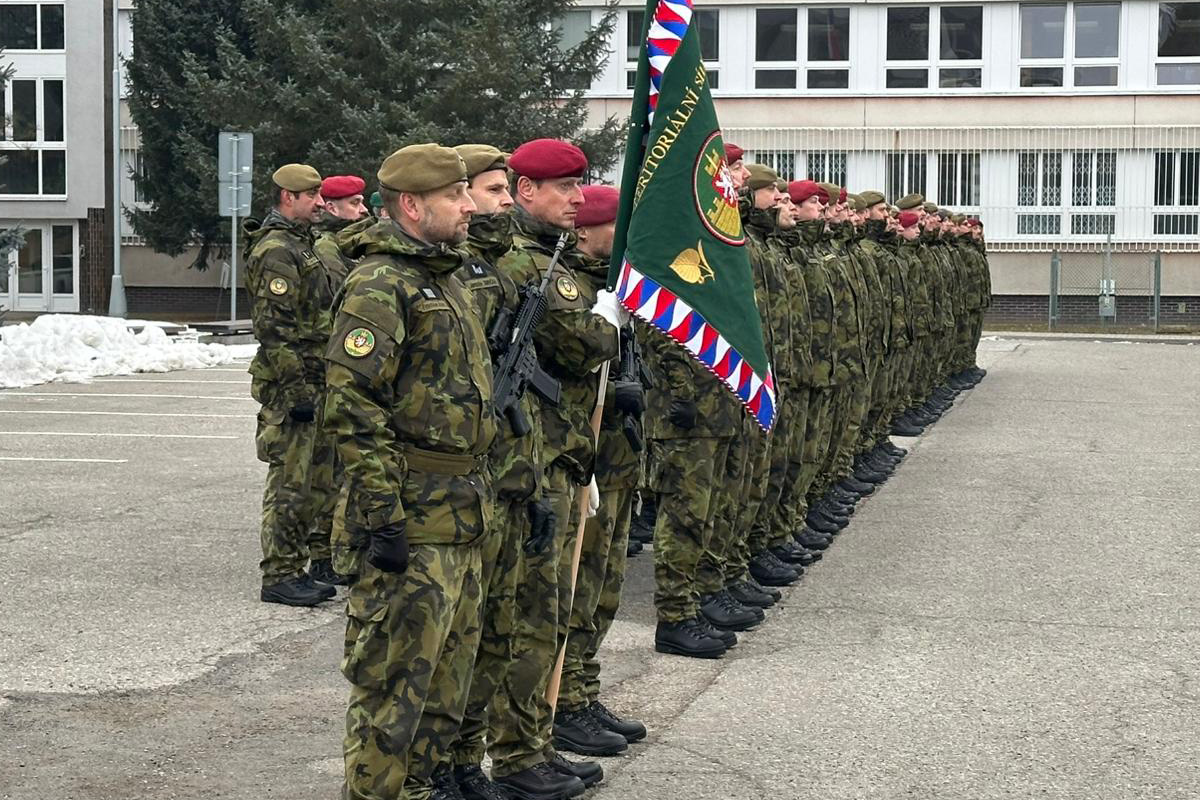
Let’s talk about the Active Reserve. The Active Reserve is undergoing a period of development. What role will it play within the Territorial Forces in the future?
A huge one, because the battalions are essentially built around it. And that’s a good thing, because they’re made up of people from the region. In the Jihlava region, you won’t find anyone from Ostrava unless they want to be there – for example, because they have a girlfriend there. Otherwise, we strictly adhere to the principle that regional territorial defense battalions are made up of people from those regions – that is, people who know the region well. There’s also a mindset that they’re truly working for their region’s internal security – for their city, for their own forest trails. That knowledge helps us, too, because when we’re securing internal security around facilities critical to national defense or critical infrastructure, we know where trouble might arise or where we have vulnerabilities. Conversely, we know where our strengths lie. Now we need to coordinate this with companies operating within critical infrastructure or facilities vital to national defense, as well as with those responsible for internal security, so that we align with our external perimeter. But those are nuances that would take me too deep into military operations.
Back to your question: the active reserve will play a huge role. We’re actually based primarily on the active reserve. Ten percent of our personnel will be professional soldiers who prepare training and lead the unit before the active reserve is called up. As soon as we call up the active reserve, we operate as a unified force. That’s how the staffing tables are structured. We’ve already increased numbers in some areas. I have to say that in roughly half the country – Jihlava, Pardubice, Brno, Ostrava, Olomouc, Zlín – recruitment is going very well. We’ve opened additional companies there, so we’re recruiting more and more people. In Brno, for example, more are waiting to join. I just discussed this with the Chief of the General Staff and made a proposal on how to open another company so we can continue recruiting. Because it’s not easy – it’s not just a matter of having people. We have to station them somewhere so we can train them and work with them.
When you mentioned Jihlava, I realized it’s a former garrison town. Is there any way you can tell that these towns still remember the military’s presence? Is there a closer connection to the military or a more open attitude toward these topics there?
The military used to be almost everywhere. Some cities remember the days when there were divisions and the like stationed there. Take Jihlava, for example – there used to be a tank division there. But I think that after the time when soldiers and garrisons were – how should I put this politely? – I don’t want to say “kicked out,” but “removed” from cities and regions – that era is long gone. Everyone knows very well that a soldier is, in a way, a trained member of society with a mindset that the team is more important than the individual. I think that helps, because soldiers are capable of helping others. And we focus on that at the DVC as well. We may discuss this further, but the point is precisely to convince people that mutual aid doesn’t cost money. Mutual aid requires only a willingness to help. And I believe the military contributes to that. Of course, the military may also boost the population’s purchasing power and things like that, but that’s more of a secondary effect. I think the psychological effect is more important.
Are the territorial forces drawing on experiences from Ukraine?
Everyone is drawing on experiences from Ukraine. It’s just a matter of realizing that not all processes, combat situations, and tactical deployments are applicable to every army. For example, in NATO, I helped build a system for which I was responsible. Some aspects have already been identified; work is underway on them; they’ve been accepted as standard practice, and things are proceeding accordingly. Others are being evaluated to determine whether they’re feasible within the framework of tactics or not. We’re still talking about drones. Yes, that’s one area that’s important. But we have to realize that their current state is also a result of the war – they’ve reached this point because, for example, the necessary technology and money are no longer available, and so on. And that, in my opinion, is an area that doesn’t resonate much here. We’re talking about two percent here and there, but in Ukraine, as the saying goes, they’ve made a whip out of a pigeon. All right, so why aren’t we building up military production? Why aren’t we manufacturing equipment the way the U.S. and other countries do today? They make missiles that are three or four times cheaper. When we compare that to the budget, we can afford to buy more of them.
But the military can’t be the one to apply that pressure. The military has competitive bidding processes, and what we’re required to do is strictly defined by law. I think it’s a lengthy process, but that’s a whole other issue. There needs to be pressure here to drive down costs. Profits don’t have to be four times higher – even a one-to-one profit margin would suffice – but it would ensure the country’s defense capability.
But who else but the military should say that this is necessary?
It requires political will. I’m not saying this shouldn’t be addressed; I’m just saying it’s beyond the soldier’s purview.
A new or modernized command and control system is being developed. How will the territorial forces fit into this structure?
I wouldn’t say a new system is being built. Of course, it’s being modernized and updated. That’s up to the Chief of the General Staff to determine. We have to realize that in a hierarchical society, the “boss” always sets up the system so that it works. We already have new communication channels, which I’m glad about because we’re sharing information. Of course, there will always be debate about how to divide the strategic, operational, and tactical levels, but please leave that to the experts at the strategic level of the General Staff. Of course, all force commanders will be invited, as the Chief of the General Staff said. We’ll discuss it, and naturally something will come of it. But this is a technical debate that I don’t think is worth addressing in public right now.
You’ve just had your first meeting with the new Chief of the General Staff of the Czech Armed Forces. Have any specific tasks or trends emerged from this meeting that you’ll be monitoring?
First, the Chief of the General Staff outlined the direction I should take. I think he accepted me for who I am. We’ve known each other for a long time. I need direction, and then I figure out the rest on my own. We each wrote at least two pages of notes. Of course, I was given tasks, and at the same time, he received feedback from me. Since I now understand this from a tactical perspective and am fully immersed in it, I shared this insight with the Chief of the General Staff. He can use it in his decision-making process – or he may not. If he uses it, I’ll be glad, and of course I’ll be happy to cooperate even if he doesn’t.
If you had to draw on one of your experiences from the NATO environment – one proven experience that would significantly advance the Czech Republic’s defense capabilities and resilience – what would it be?
In Poland, as well as in some other countries, soldiers aren’t afraid to communicate with local factories or the local manufacturing infrastructure. After all, who has better experience than the people who actually use these things? Here, it still seems to me that we view this as if someone is trying to line their own pockets. But that’s not the case. All regular soldiers are evaluated and monitored by various organizations that oversee us. Anyone who would even consider lining their own pockets has no place there. But feedback from actual use – about what’s actually needed – must be direct. You can see this in Ukraine. There, generals, colonels, and even lieutenants sit down with people from the factory and tell them how to change those things. That’s something we’re still lacking here.
We have some industry days; the ministry is handling that, of course, but I still think it’s a bit too organized. The point is to find a balance, to ensure there are no leaks and that information that shouldn’t be made public doesn’t get out. It’s about training people, their mindset, and mentoring. But we’ll get there. I believe we’ll get there because circumstances will force us to.
It all comes back to the resilience of the state and the population. Because when these issues are discussed in society, it will naturally lead to people becoming more aware of them.
The previous Chief of the General Staff already said that we need to experiment and try new things more. I believe the current Chief of the General Staff will take the same approach, based on what I’ve heard from him. Now it’s just a matter of finding processes so that we don’t accuse each other of doing something wrong, even though it was truly done in good faith to improve, say, some equipment or a weapon. I remember when we received the BREN in Afghanistan; we were forbidden from discussing many things. Today, it’s a weapon the whole world wants. That’s because it has undergone development and practical testing – the kind only a soldier can provide. A company can’t figure that out by firing six thousand rounds. We really need to work through this together and help one another so we can get the job done.
You said that the territorial forces organized this year’s voluntary military exercises. Is this the way to go? It only applies to the youngest generation. Is there any way to expand this to include more target groups than just high school students?
The Chief of the General Staff has issued a directive to create opportunities for college students attending civilian universities as well. Even the minister has said he would like to see departments established at universities. I think this is an excellent approach, because in a way, we’ll be able to select highly educated personnel while also addressing a social issue through recruitment incentives. It will be a “win-win” for both sides. Let me return to the DVC program for high school students. I think it’s amazing. Whoever came up with this idea – or whoever was responsible for getting it started – should receive a medal, because it’s amazing.
We bring in 18-year-old high school students who are enthusiastic and tackle every challenge. And even within that one month, you can see how they learn to work together and how they learn to assess who has strengths and weaknesses in different areas. When they leave, it’s really clear that they’ve become a good team and know how to help one another. When I spoke with them, I told them: Look at what you can do. For example, I have the First Responder app. It’s an app that, when you turn it on and know you can provide first aid, lets the Integrated Rescue System (IZS) know you’re there whenever something happens – and they can send you a text message or an alert asking you to go resuscitate someone who’s collapsed. After all, it’s just a small contribution from an individual to help keep society safe – so that we can save each other’s lives. And that’s what these 18-year-olds – I don’t want to call them “kids” – learn to recognize during their DVC training.
It’s not just about shooting, tactics, survival, or learning how to make a fire or a shelter. It’s also about helping others. And first aid is one of the fundamentals. I think this is only good for society. And I come back to the fact that we’re just getting started. It’s a shame that in the 1990s we lost a generation – or two – of people who thought only of themselves. Maybe what I’m saying sounds harsh, but I’m sorry. Those are my opinions.
We both remember a time when providing first aid or knowing how to handle certain light weapons, for example, was a normal part of life for us, as young people back then. That’s why I think it makes perfect sense for the majority of society to possess these skills – at least in the medical field.
When I travel around the country or give lectures at universities where I’m invited, I speak, for example, about critical infrastructure. We have a group here with a lot of incredibly smart people. These people translate legal provisions into practical explanations of what might actually happen, so that everyone can understand.
I really think this resonates very well. And I would be absolutely delighted if the territorial forces were seen as entities that connect various associations and organizations in the regions – ones that can support one another, so that we’re aware of each other and, when the time comes for necessary coordination, can call on one another and know who can contribute what and how they can help. That’s why, for example, I’m currently holding an expanded meeting with KVV directors and battalion commanders, to which we’ve also invited representatives from airsoft clubs across the Czech Republic. Because I think this is also an opportunity for us to learn from one another. I’ve spent enough time abroad, and I think we can put these ideas into practice. We won’t be inventing anything new. We just need to keep an open mind, be willing to communicate, and figure out where we can help each other within the law – where we can work together for the good of the country.
By the way, how mentally challenging is it for a professional soldier to acknowledge that airsoft players are actually kind of soldiers, too?
It’s definitely not a problem for me. We have our own civilian sport shooting club, where all kinds of people come together. There are guys there with whom we once embarked on our first missions, and today they’re customs officers or police officers. We have a guy there who helps people deal with debt, a guy who works in administration, and a girl who’s a teacher. That’s what community is all about. Everyone has a skill. We can joke with each other about how the police do things better than soldiers – and vice versa. That’s normal; they’re just little spats. But when you put us together, we’ll always function as a team. And that’s the beauty of it. What we have on a small scale in our shooting club can be scaled up to the regional level through cooperation between regions, active reserves, and so on. And if we take this as our ultimate goal – as our vision – then I think things will turn out well.
You mentioned that you’re a little ahead in some areas when it comes to building up the Territorial Forces. So when will the Territorial Forces be “ready” as part of the Czech Republic’s defense?
They already are. You know what? A soldier always goes out to carry out a mission with whatever he has. So I have a certain number of troops right now, and we’re using them to carry out our mission. It’s important to realize that if the government now says – and it will always be up to the government and parliament to decide – that in peacetime we are to guard facilities critical to national defense in anticipation of a conflict, then of course the strategic level, the Capability Planning Section, the Chief of the General Staff, all these elements, and then the operational headquarters will all cooperate on this. I’ll say: “Fine, but if you’re asking so much of me, I’m capable of doing three-quarters of it, or I’ll spread myself so thin that it won’t be covered perfectly, and someone else will have to do the rest.” And if I don’t have active reserves, someone else will have to do the rest.
And that’s exactly the kind of thinking we need – how we can help each other to ensure everything is secure, so that some troublemaker from outside doesn’t pull a stunt on us here, and so that people don’t end up needlessly afraid because of it.
Related