















C-390: The Renaissance of the Czech Air Transport Force and Its Significance for National Prestige
The first of two C-390 multipurpose transport aircraft ordered from Brazilian manufacturer Embraer is expected to land soon at the 24th Air Transport Base in Kbely, Prague. This will mark the largest expansion of the Czech Air Transport Force’s capabilities in the history of the independent republic. What does this mean, specifically?
The Importance of Transport Aviation at the Strategic Level
To understand the significance of this project, it is important to realize that, thanks to the introduction of the “390” into our Air Force’s arsenal, the Czech Republic will, for the first time ever, gain the capability to transport armored vehicles by air and to refuel both its own and NATO aircraft in flight. This is no small step forward in the Air Force’s capabilities. It represents a significant strengthening not only of our own air force but also of the country’s overall standing on the international stage. After all, the airlift of personnel, equipment, and supplies is a vital capability even for armies with navies. This is all the more true for landlocked countries; and it is by no means limited to the need for expeditionary deployments in COIN (counterinsurgency) operations.
The evacuation of its own citizens (whether due to a crisis, war, or natural disaster) from abroad; the transport of supplies (whether medical supplies, key components for weapons systems, or ammunition); and the transport of military personnel (rapid deployment of light forces, medical evacuation) and equipment—these are capabilities applicable to a wide range of scenarios. When we add the capabilities of aerial refueling (albeit currently only via the probe-and-drogue method) and aerial firefighting (both of which have the potential to be utilized by our allies and partners as well), the C-390 becomes not only an effective military tool but also an instrument of the state’s foreign policy.

Industry in the Spotlight
In addition to the aforementioned military and strategic impact at the national level, the collaboration between Embraer and the Czech company Aero Vodochody is also having a positive impact on the industry. In Vodochody, leading edges for the wings and the rear section of the fuselage are manufactured for the C-390. As the success of this aircraft in Europe grows—and it can, without exaggeration, begin to be regarded as a replacement for the legendary C-130—the number of orders for Aero is also increasing, and this existing collaboration holds the potential for further expansion of production and maintenance services. It is worth noting that the C-390 is already in service with—or has been ordered by—the air forces of Portugal, Hungary, Austria, Sweden, the Netherlands, the Czech Republic, and Lithuania, and Embraer’s product is also a strong favorite for Slovakia. This makes the C-390 a significant and widely adopted solution in this category across Europe.
A New Addition to Our Oldest Air Base
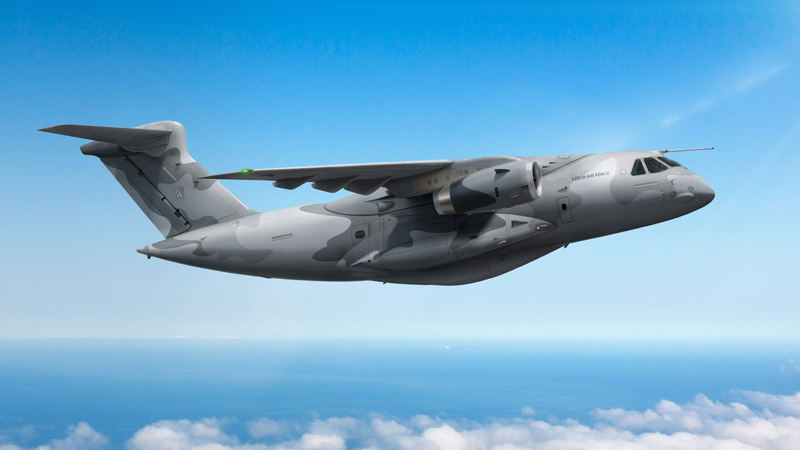
As previously mentioned, the first of our C-390s has completed a successful maiden flight and, following further work and the application of a new camouflage scheme, will land at the Kbely Air Base in the near future. According to available information, the second aircraft is expected in 2027 or 2028. In addition to the aircraft themselves, our order also includes a wide range of support and auxiliary equipment. Simulators, training and maintenance facilities, a large set of spare parts, an operations and maintenance planner, equipment for special operations, a firefighting and refueling kit, equipment for ground refueling of vehicles, an air ambulance module, and equipment for search and rescue operations. This will enable a wide range of potential deployments and allow us to fully utilize the potential of this emerging standard in transport aviation.
The current number of new transport aircraft, influenced by personnel and financial constraints, is sufficient to acquire these brand-new capabilities that our transport aviation has not yet possessed. In the long term, however, two aircraft—as is the case with other types of equipment—fall short of the minimum threshold for a truly sustainable and operationally viable fleet. Therefore, we can only hope that the C-390 fleet will be expanded in the future, just as was the case with the C-295MW Casa aircraft. As a reminder, in 2020, a decision was made to expand the in-service C-295 fleet from four to six aircraft. This step had a positive impact on the fleet’s long-term operational readiness and deployability, as well as on the overall capabilities of the 24th Air Base. A similar expansion (i.e., by 1–2 aircraft) would also have long-term positive effects in the case of the new jet aircraft from Brazil.
Regardless of future developments, one thing is clear. With the C-390, the Czech Republic—specifically, the Czech Air Force—will significantly strengthen its airlift capabilities and, along with that, gain entirely new capabilities that can be utilized at both the national and international levels.