















Technology as the new battlefield: How science and innovation will transform the security landscape by 2045
The security environment of the next two decades will not be determined solely by the number of tanks, aircraft, or missile systems. The main transformation will take place in an area that is less visible but strategically crucial—in science, technology, data, biotechnology, access to resources, and the information space. It is here that decisions will be made about future military superiority, the resilience of states, and who will be able to survive in an era of permanent technological competition.

This development is also systematically highlighted in the alliance's analysis of macro trends in science and technology for the period 2025–2045 (NATO STO Science and Technology Trends 2025-2045 VOL.1), prepared by the NATO Science & Technology Organization.
The document shows that technology is no longer just a tool of power. It is becoming the very environment in which geopolitics, economic competition, and conflicts of the future will take place.
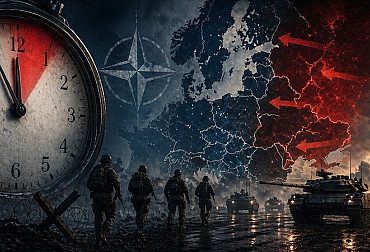
Basic trends:
The security environment as a technological ecosystem
The fundamental shift lies in the fact that security is no longer just a question of military power in the traditional sense. It is the result of a complex technological ecosystem in which defense capabilities, civil infrastructure, digital networks, private companies, scientific research, and public opinion intertwine.
Technological superiority thus becomes not only a means of deterrence, but also a source of vulnerability. The more advanced and interconnected a society is, the greater its potential for innovation—but at the same time, the wider the spectrum of areas where it can be disrupted.
1. Transformation of areas of strategic competition: war without a front line
One of the most significant trends is the shift of strategic competition from traditional battlefields to new domains. Cyberspace, outer space, the information environment, and the gray zone are becoming the primary arenas of conflict.
- Hybrid action as the new standard
Hybrid instruments—cyber attacks, economic pressure, information manipulation, sabotage, or the use of proxies—allow states to weaken their adversaries without crossing the threshold of open warfare. Technology plays a dual role here: it enables precise, rapid, and difficult-to-attribute operations, while increasing the target states' dependence on vulnerable systems.
Future conflicts may therefore be long-term and covert, without a formal declaration of war, but with cumulative strategic impacts.
- Space as a critical vulnerability
The space domain deserves special attention. Today, satellite systems provide navigation, communication, meteorological data, financial synchronization, and military command and control. Their disruption—whether by physical means, cyber attacks, or signal jamming—can paralyze military operations and the civilian functioning of the state.
Space is thus becoming not only a means of supporting operations, but also a separate battlefield where confrontation below the threshold of open conflict can occur.
2. The race for artificial intelligence and quantum technologies
The second key trend is accelerating global competition in artificial intelligence (AI) and quantum technologies. These areas have the potential to fundamentally change the nature of military and civilian capabilities.
- AI as a power multiplier
Artificial intelligence is making its way into operations planning, intelligence data processing, network protection, autonomous systems management, and logistics. Its main benefit is not replacing humans, but increasing the speed and quality of decision-making in a data-saturated environment.
A country that can effectively integrate AI into its military structures will gain an advantage in terms of response speed, strike accuracy, and adaptability. At the same time, however, there is a risk of dependence on algorithms whose functioning can be difficult to explain or control.
- The quantum revolution in security
Quantum technologies represent another potential breakthrough. Quantum sensors could enable the detection of objects that are currently difficult to detect, quantum navigation could offer an alternative to satellite systems, and quantum computers could break current cryptographic standards.
This has direct security implications: communication protection, classified information storage, and financial system security will have to undergo a fundamental transformation.
- The ecosystem is more important than the technology itself
However, it will not only be technological progress itself that will be decisive, but the entire ecosystem surrounding it—access to data, computing capacity, energy resources, and, above all, human capital. The battle for talent in the fields of AI, quantum physics, and data science is becoming a strategic competition comparable to the battle for mineral resources.
3. The biotechnology revolution and a new dimension of security
Biotechnology, especially synthetic biology, is considered to be the next big technological wave. Its impact will be felt in medicine, agriculture, materials science, and energy.
- Benefits and risks
Personalized medicine, rapid vaccine development, more resilient crops, and biomaterials can significantly improve quality of life and societal resilience. At the same time, however, barriers to the misuse of biological processes are falling.
The combination of genetic engineering, advanced data tools, and AI can accelerate the development of dangerous biological agents. The threat of new-generation biological weapons, potentially targeted at specific groups, is thus becoming a security issue that cannot be ignored.
- Biology as a strategic domain
Biotechnology is gradually becoming a strategic area, similar to nuclear energy in the 20th century. The difference lies in the wider availability of technologies and the reduced possibility of central control. Research protection, ethical standards, and international cooperation will therefore be key elements of security policy.
4. The growing gap in access to resources
Technological development increases demand for energy, critical raw materials, and stable supply chains. At the same time, climate change increases pressure on water, food, and the habitability of certain regions.
- Technology as both a solution and a problem
AI, new materials, and green technologies can help optimize resource use and mitigate the impacts of climate change. At the same time, however, they can exacerbate inequalities if they remain concentrated in technologically advanced countries.
The result could be a world where technologically advanced countries strengthen their resilience, while other regions face a combination of environmental, economic, and security crises.
5. The information environment and the erosion of trust
The digital environment is becoming a key battleground for the minds of the population. Generative AI makes it possible to create convincing but false content on an unprecedented scale. Trust in institutions, the media, and science is being undermined.
For adversaries, it is a cheap and effective tool for strategic influence. For states, this means that defense is no longer just a matter of physical borders, but also of protecting the information space and social cohesion.
6. Technology addiction as a new vulnerability
Modern armies will increasingly depend on civilian technologies and the private sector. Innovations in AI, space systems, and biotechnology are largely emerging outside the traditional defense industry.
This brings new capabilities, but also dependencies on commercial suppliers and global supply chains. Interoperability between allies is becoming more complex, as individual countries may have different technological levels and regulatory frameworks.
Implications for the Czech Republic and the Czech Armed Forces
For the Czech Republic, these trends mean that future security will depend on the ability to:
- integrate advanced technologies into defense planning
- work systematically with data and digital skills
- protect the information environment and societal resilience
- develop cooperation between defense, academia, and industry
- build technological literacy within the armed forces
The Czech Army will not compete for global technological supremacy, but it can build a strong position in specific areas of specialization—such as cyber defense, data analytics, unmanned systems, and critical infrastructure protection.
Conclusion: Security as the ability to adapt
The security environment until 2045 will be shaped primarily by the speed of technological change. Countries that manage to link innovation, defense, and societal resilience will gain a significant advantage. Those that remain technologically dependent and institutionally slow may become a space where rivals wage their technological conflicts.
Technology is no longer just a tool of power. It is the security environment itself. And the ability to adapt quickly in this environment is becoming one of the main measures of a country's strategic strength.