














Lt. Col. Peterek and Lt. Col. Knapek: The key to maintaining momentum is modularity, openness, and rapid technology testing
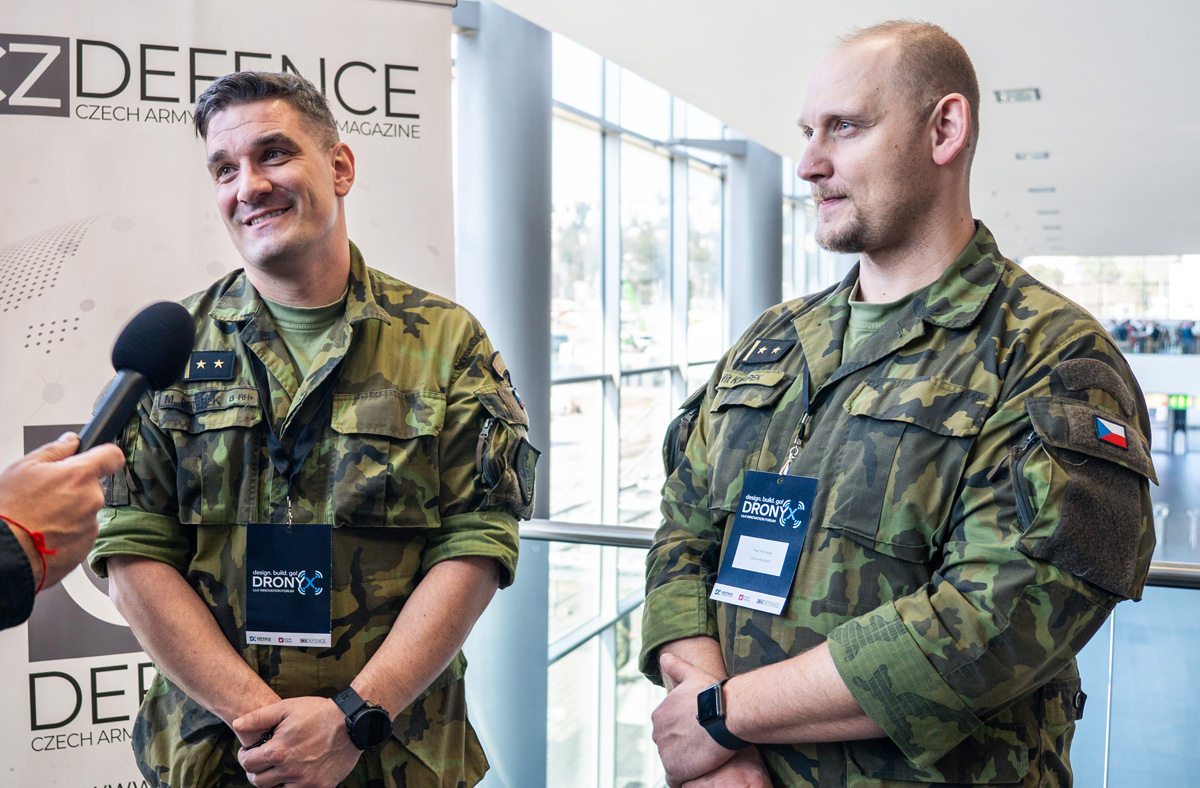
The rapid pace of technological development in the field of unmanned and autonomous systems presents the Czech Armed Forces with a fundamental dilemma: how to ensure that newly introduced technologies are not already obsolete by the time they are deployed. According to Lt. Col. Michal Peterka of the Ministry of Defense’s Communications and Information Systems Section and Lt. Col. Vít Knapek, commander of the Center for Deployable Systems and Command and Control Technology Development, the answer lies primarily in an emphasis on modularity and open architecture. You can learn more in the following interview, which took place at the recent DronyX conference, where both officers spoke on behalf of the Czech Army as panelists.
Video: Lt. Col. Peterek and Lt. Col. Knapek: The key to maintaining momentum is modularity, openness, and rapid technology testing / CZ DEFENCE
Modularity and planned upgrades as standard
Both officers agree that current systems must be designed from the outset to allow for ongoing modifications and upgrades. In practice, this means that further development over the system’s lifecycle is factored in at the procurement stage. This approach reflects the reality that technological progress on the battlefield occurs over the course of years, not decades.
A key factor is also the effort to avoid closed “black box” solutions and instead favor open systems that can be further developed and adapted to new requirements.
A proactive approach and international cooperation
When it comes to monitoring new technologies, not only the institutional framework but also the personal initiative of experts plays a significant role. According to Peterka, work in this area is often a personal interest as well, which translates into exceptional dedication.
Another important element is close cooperation with foreign partners within NATO, the sharing of experiences, and participation in international exercises. In addition, however, the military also emphasizes its own testing, for example through various exercises where technologies are tested under domestic conditions and presented directly to end users.
Conferences as innovation accelerators
During the interview, both respondents praised the growing importance of professional conferences such as DronyX, which facilitate direct contact with the industry. According to them, these platforms significantly simplify the initial orientation within the technological landscape and enable the rapid establishment of collaborations.

At the same time, they pointed out that the presentation of technologies alone is only the first step. The true verification of their benefits comes only through subsequent testing, which will show whether the declared capabilities match reality.
Another interesting benefit of these events is the opportunity to identify existing solutions for needs that would otherwise require complex development. In some cases, this can mean a significant acceleration in the implementation of new capabilities.
Startups as a source of innovation
According to Lieutenant Colonels Peterka and Knapek, startups play a specific role in the innovation ecosystem. They excel primarily in flexibility, responsiveness, and the ability to adapt to the military’s specific requirements.
On the other hand, there are established companies, which, while possessing greater capacity and experience, often lack the dynamism of smaller entities. The ideal model, therefore, lies in a combination of both approaches, with startups serving as a source of breakthrough innovations.
The future: autonomy and trust
According to both officers, significant further development of unmanned systems across all domains can be expected in the coming years. A key trend will be, above all, an increasing degree of autonomy, which will enable systems to perform tasks with minimal operator intervention.
However, the fundamental change will not be merely technological, but also psychological. A decisive factor will be users’ trust in these systems and their ability to integrate them into the units’ day-to-day operations. As in the civilian sector, we can expect these technologies to be gradually adopted as standard tools.
Artificial intelligence under human control
There is a consensus in the field of artificial intelligence that its role will primarily be supportive. These systems are intended to quickly process large volumes of data and provide relevant information for decision-making.
However, according to Peterka and Knapek, decision-making authority will remain with humans for the foreseeable future. Maintaining human control is considered essential, particularly when it comes to the use of weapon systems.
The need to accelerate progress in the areas of UxS and C-UxS
Lieutenant Colonel Knapek identifies the need to significantly accelerate the development of capabilities in the field of ground- and air-based unmanned systems (UxS) and counter-drone technologies (C-UxS) as a key priority. According to him, the rapid pace of their development and short life cycle leave no room for delaying decisions.
In this regard, Lt. Col. Peterek points to the growing quality of the Czech defense industry in this field. Czech systems are already being deployed in real-world conflicts and are proving their effectiveness, even though their development and production are subject to more demanding compatibility standards within NATO.