






Europe’s New Security Architecture: The Czech Republic Could Secure a Seat at the Negotiating Table Through Military Logistics
A very clear message resonated at the recently concluded Warsaw Security Forum: the European security architecture is undergoing a profound transformation, and the era when NATO membership meant automatic security for all is gradually coming to an end. European Commissioner Andrius Kubilius and U.S. Ambassador to NATO Matthew Whitaker spoke openly there about the transition to a new model known as “NATO 3.0.” The United States is moving away from a system in which everyone was measured by the same yardstick at the negotiating table, regardless of their actual contribution. Instead, transactional pragmatism is taking hold. Influence now lies with those who make a real and tangible contribution to European defense.
What does this strategic doctrine mean in practice? Europe must fully assume responsibility for its conventional defense, while the United States will retain more or less only the role of a nuclear umbrella on the continent and shift its main strategic forces to the Indo-Pacific.
The problem, however, is that protracted negotiations among all thirty-two member states in Brussels are slowing down this transformation. The United States is therefore beginning to carefully select partners in Europe and is developing a mechanism to put NATO 3.0 into practice. Instead of seeking a broad consensus, U.S. Deputy Secretary of Defense Elbridge Colby is forming an informal coalition of willing and capable states known as the Bergen Group. Only six countries were invited to the negotiating table: Norway, Sweden, Finland, Germany, the Netherlands, and Poland. It is within this exclusive circle that the so-called “capability clusters” are being discussed—that is, the precise division of which country will assume which military and financial role once the United States begins withdrawing its forces from the continent.
This selection of participants is drawing considerable attention within NATO circles. It is not merely a matter of meeting financial criteria; missing from the table are both traditional powers with large armies, such as the United Kingdom and France, and the Baltic states, which, in fact, spend the most per capita on defense in Europe. In short, the United States is giving preference to closer, more direct partnerships with selected countries, led by Poland, with its unprecedented defense spending of 4.7% of GDP, and the Nordic countries, with their modern armies. A spokesperson for the Czech Ministry of Defense officially confirmed that the Czech Republic did not receive an invitation. For Prague, this is a clear signal that mere formal membership is no longer enough to open the door to these key debates. This will make Defense Minister Jaromír Zůna’s position all the more difficult during his trip to the U.S. and his direct talks with the architect of this selective approach, Elbridge Colby.
The presence of the Netherlands is particularly inspiring; it sits at this exclusive table not because it has a massive military, but because it represents the ideal combination of a responsible ally and a key logistical gateway. Deep-water ports there, such as Rotterdam, are absolutely essential for unloading heavy U.S. military equipment, and the interconnected infrastructure ensures its rapid transport eastward. The U.S. is thus clearly demonstrating that it values not only frontline soldiers but also flawless logistical support. This is particularly important given that the Pentagon ordered the withdrawal of approximately 5,000 U.S. troops and a strategic long-range artillery battalion from Germany back in May. The Americans have thus sent a clear message to Europe: you must now take care of missile support and the movement of equipment on your own.
For the Czech Republic, this shift in the U.S. approach to European defense represents a serious warning. While politicians in the domestic political debate often take pride in formally fulfilling the alliance commitment – that is, enacting legislation to spend 2% of GDP (although actual spending this year amounts to roughly 1.8%) – Washington now considers this an insufficient minimum. Ambassador Whitaker in Warsaw did not hold back in his criticism of Czech spending and confirmed that he had recently delivered a very sharp message to Czech leaders. The U.S. is thus reinforcing its view of the Czech Republic as a free rider that is merely tagging along on Europe’s security architecture.
The new benchmark being considered to maintain the NATO 3.0 operational model requires massive investments not only in weapons but also in broader infrastructure – for which European countries currently lack hundreds of billions of euros. Does this mean that the Czech Republic must become a military powerhouse with a massive army overnight just so the Americans will take notice of us again? No. The key to strengthening the Czech Republic’s strategic role may not lie solely in extensive investment in military equipment, but above all in the effective use of its geographic location.
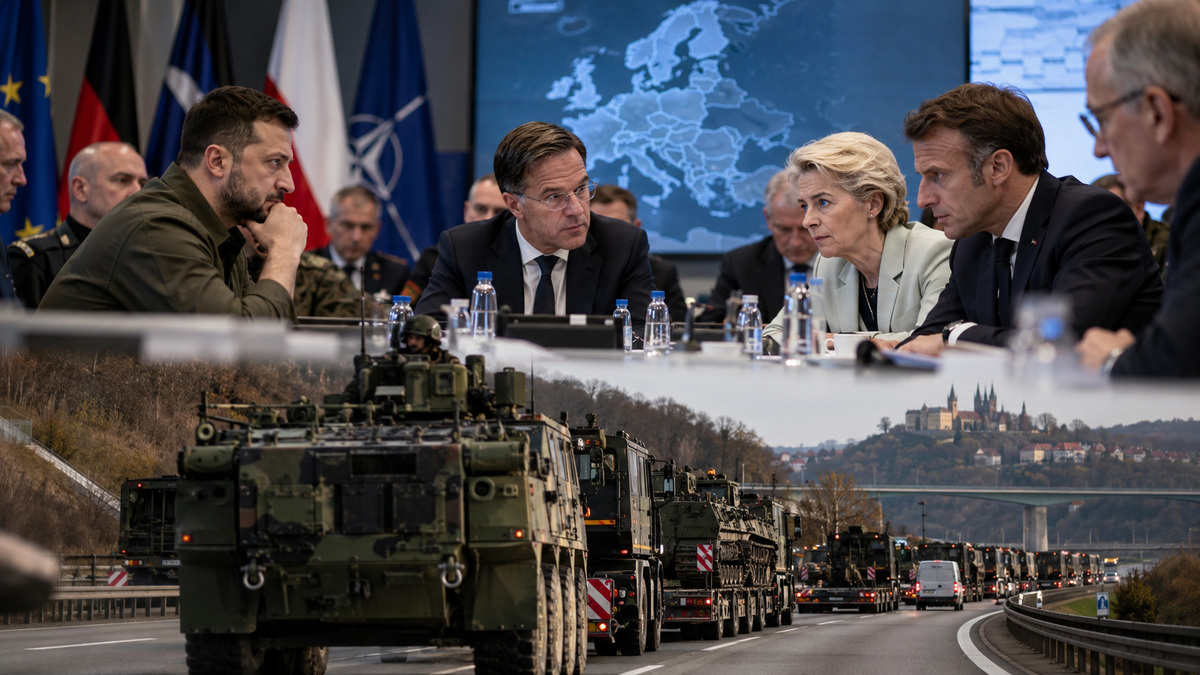
We are not on the front lines; those are located on the eastern flank. As the center of gravity of European defense shifts from the west toward Poland and the Baltic states, our greatest asset is our logistical and transit potential. In fact, former Chief of the General Staff Karel Řehka has long drawn attention to this fact, repeatedly warning that the Czech Republic’s role in the event of any crisis will be primarily one of transit, and our infrastructure must be 100 percent prepared for this.
Simply put, the Czech Republic should function as a high-capacity and fast transit hub. If we fail to secure key infrastructure—including bridges capable of supporting modern heavy equipment, passable highways, and reliable rail corridors—we will merely be an obstacle to allied troop movements. Targeted investments in so-called military mobility, on the other hand, can make us a strategically indispensable partner.
The Czech Republic thus faces a strategic choice. Relying on the assumption that mere membership in the Alliance is a sufficient and unquestionable guarantee of security carries the risk that decisions about our region will continue to be made behind closed doors without our participation. It would be far more pragmatic to accept this new geopolitical reality and draw inspiration from the Dutch approach. If we fulfill our financial commitments and offer our allies key logistical support, we can become a partner without whom the eastern flank of Europe simply cannot defend itself.
Related