















Chief Warrant Officer Michal Baka: Believing new technology will teplace skill Is not the way forward
The modernisation of the Army is not, for example, just about new howitzers with longer ranges. According to Chief Warrant Officer Michal Baka of the Army, while the equipment itself increases lethality and the chances of survival, it also places enormous demands on training, logistics, and, above all, the soldiers’ mindset. According to him, the Czech Army will never win through quantity, but must focus on quality, education, and the ability to utilize information across domains.
Video: Rozhovor s vrchním praporčíkem Pozemních sil AČR št. prap. Michalem Bakou / CZ DEFENCE
In this interview, we focused on the specific impacts of the modernization of the Czech Army’s Ground Forces. “If we take the CAESAR project as an example, the artillery’s range will increase by at least fifty percent. Modernization programs are thus rapidly increasing the lethal capabilities of units, which is the greatest benefit,” notes Baka, who adds, however, that this is not just about numbers on a spreadsheet: “As the geometry and anatomy of the battlefield shift, what used to be true no longer applies today, precisely because of modern technologies. Modernization of the ground forces increases the lethality of our units so that we can operate more effectively and more quickly.”
However, the fundamental changes lie not only in technology, but also in how the military prepares overall. Michal Baka acknowledges that high-intensity conflict is now the dominant threat, but at the same time rejects dramatic interpretations: “I’m not saying we didn’t need to revisit certain things, because they’re done differently than in missions abroad. On the other hand, I don’t think this is such a radical change that it would drain too many of our forces and resources. The basics are still the same—firepower, movement, communication.”
We also asked the senior warrant officer what he currently sees as the greatest weaknesses in the ground forces. “We need to step up our game in every area. What concerns us most right now—and falls entirely within my purview—is the mindset of the soldiers. Thinking that new technology will replace skill is not the way to go. Technology is a useful supplement, but the moment we start relying on it and abandon the basics, it’s a road to hell,” says Baka, adding that every expansion of capabilities has a ripple effect. “When we expand our capabilities and want to reach further, we need to see more than just fighters. The old truths still hold: infantry may win a battle, but logistics wins wars,” explains the staff sergeant. At the same time, however, he adds that the army simply cannot do without commanders and educated personnel, which is, after all, evident in Ukraine as well.
Regarding current projects within the military, Baka states: “We are currently working intensively on a program we call the Soldier Letality Program. The fundamental building block of the military is the individual or the team, but we are still talking about the soldier. We want to refine our programs related to equipment, armaments, and technology to perfection so that we can reduce unnecessary burdens while achieving our target capabilities.” The sergeant then gives a practical example: “When we talk about operational capability for at least 72 hours, simply carrying ammunition, water, and everything a person needs places demands on equipment, armaments, and survival capabilities. We look at Ukraine; we look around us. The Polish Army has a very interesting program. We could adopt many of these ideas and adapt them to conditions in the Czech Republic. At the same time, however, we must be selective. An army of half a million people is organized differently than an army of 25,000 to 40,000 people,” adds Baka.
In the Army, modernization is most clearly reflected in the capabilities of individual soldiers. “I joined in 2005. We had the vz. 58 submachine gun—made of plywood, with mechanical sights,” recalls the Chief Warrant Officer, adding: “Today, basically every soldier has a red dot sight, night vision equipment, and so on. We’re increasing the technological complexity of what a soldier carries and what they must be able to operate. This increases lethality, but also survival time. If I spot the enemy sooner, I can act sooner—and I have a better chance of surviving. For a small professional army, this is key. We’ll never have quantity; we have to focus on quality.”
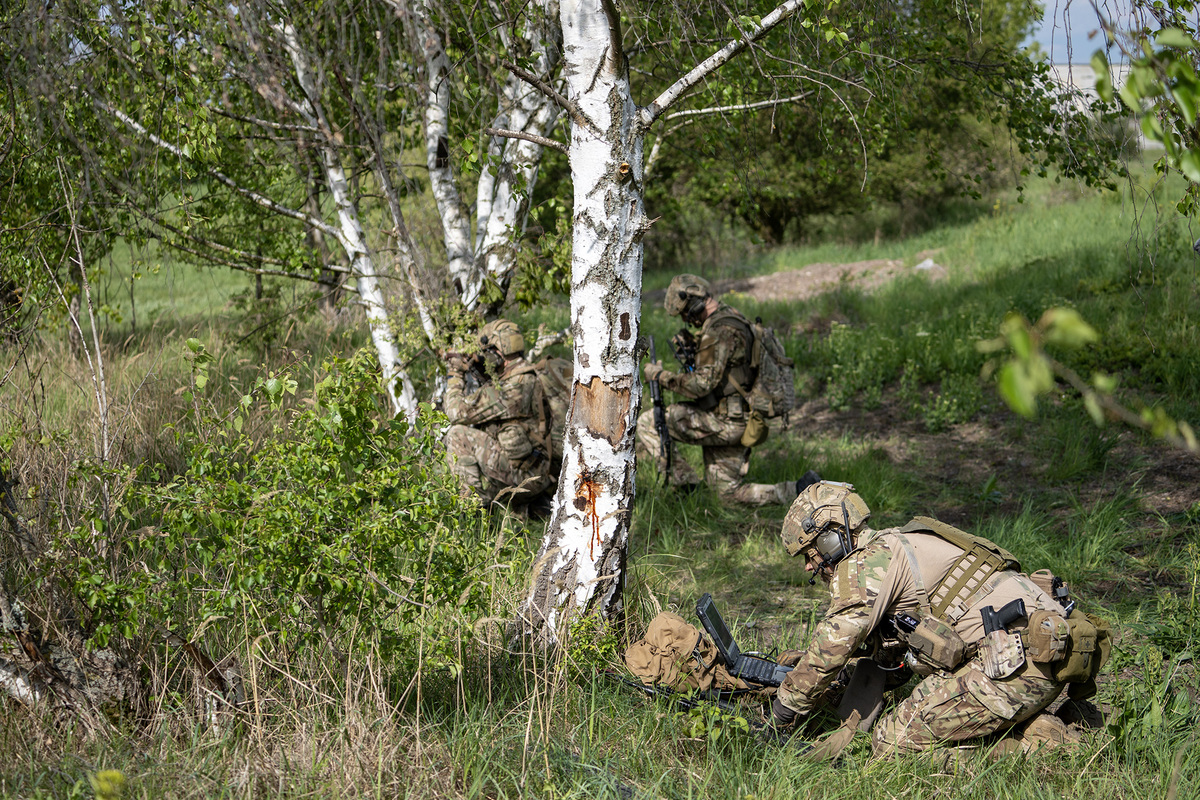
In response to our question about the “optimal equipment” for a 21st-century soldier, Michal Baka notes that there is no one-size-fits-all list. “Equipment and gear are always dictated by the mission. There’s a difference between moving 30 kilometers on foot and then engaging the enemy, and traveling those 30 kilometers by vehicle. There’s a difference between engaging in combat and then having to walk 30 kilometers back,” explains the Chief Warrant Officer of the Ground Forces.
And because ground forces cover a wide range of missions, the need for a diverse array of equipment is also growing. “We try to cover almost everything from the North Pole to the South Pole, which requires a corresponding range of weapons. Take our mountain commandos, for example—there, it’s not even worth firing with a 5.56-caliber round and an 11-inch barrel. The 7.62×51 caliber takes on a whole new significance in the mountains,” says Baka.
And what defines the modern battlefield today? “Optical devices speed up targeting and increase the chances of hitting the target. Thermal imaging cameras, surveillance equipment… the battlefield is flooded with them. Every member of the ground forces should have access to the full range of equipment so they can perform at 100 percent,” notes the Chief Warrant Officer Baka.
The Senior Warrant Officer of the Ground Forces combines practical testing and familiarization with equipment with the St. Wenceslas Cup competition, of which he is the main organizer. “Ballistic protection is mandatory—plates in the vest, a ballistic helmet. And we leave the equipment up to the competing soldiers. In recent years, we’ve done it so that it pays off for people to adjust and rearrange their gear day and night to gain an advantage,” says Baka, also mentioning another benefit of the competition: “People see what’s possible under current regulations. The sterility of the shooting range—here’s the firing line, here’s the target, I shoot forward and nothing else—is slowly breaking down. And the stereotype of ‘that’s how it’s always been done’ is shattering.”
However, he believes that technology will never replace an individual’s skills. “There’s a great example in special forces. You start with mechanical sights until you have a solid foundation. Only then do you get a red dot sight, and then optics. A person should have pure skill and use technology to help them, to be faster, more accurate, and lethal,” says Baka, who warns against false shortcuts: “Thermal imaging isn’t a silver bullet if I don’t know when to look through it and what to watch for. Thinking that thermal imaging will fully replace night vision won’t work. They have to work in harmony. As I say, a good servant, a bad master.”
The modernization of the military must be integrated with command structures. In this regard, according to Baka, the pressure is mounting, particularly on non-commissioned officers. “The demands on non-commissioned officers are clear: they must look two levels up and understand the chain of command. The basic building block on the battlefield is the squad—and the squad is commanded by a non-commissioned officer. He knows better than a two-star general how to accomplish the mission at a given time and place. And at the same time, they must understand technology and weapon systems. These are the people on whom effectiveness depends,” explains the staff sergeant, adding: “We’re trying to create the conditions and pressure so that as many commanders as possible understand that mission command is the philosophy we want to follow. Sometimes there’s friction; occasionally, direct orders have to be given. But in our team, we operate purely on mission command: the general gives the task, and I carry it out. Once I’ve completed it, I come to report that it’s done—and how,” Baka describes.
An important factor for the military is not just recruitment itself, but also how quickly a civilian can become a soldier capable of holding his own in modern warfare. “I can’t fully evaluate the recruitment methodology; that’s beyond my purview. But it’s true that we need more soldiers,” says the Chief Warrant Officer of the Ground Forces, adding that he sees potential in programs that allow people to get a taste of military life: “Voluntary military training is a good approach. However, there is still a certain barrier. People don’t want to step into the unknown; they don’t want to leave their comfort zone. We need to adapt the training programs so that we can get them to the level we want as quickly as possible.”
When asked how long it will actually take, Baka refuses to throw out random numbers. “It varies greatly from person to person,” he says. “It makes a difference whether someone arrives physically fit. It makes a difference whether they come from a military family. And above all, there’s a difference between a drone operator, an electronic warfare specialist, and a tank crew. The Leopard 2A8 is basically an F-35 on tracks. We don’t know what we’re getting into. We can’t estimate how long it will take us. The motto ‘we’ll train a gunner in three months in Vyškov’ definitely doesn’t apply.”
We were curious to what extent recruits’ expectations differ from reality. “Expectations vary. Action movies and games distort things—when it rains, it rains on the screen, but I’m not the one in wet clothes. And when you’re running with 30 to 50 kilograms of gear, you don’t feel it on the screen, but in real life, you do,” says Baka. However, he views this clash with reality as part of resilience: “Exposing people to the problems of everyday life can build a more resilient society. We have to adapt. Attitude is everything, and we have to change and improve it.”
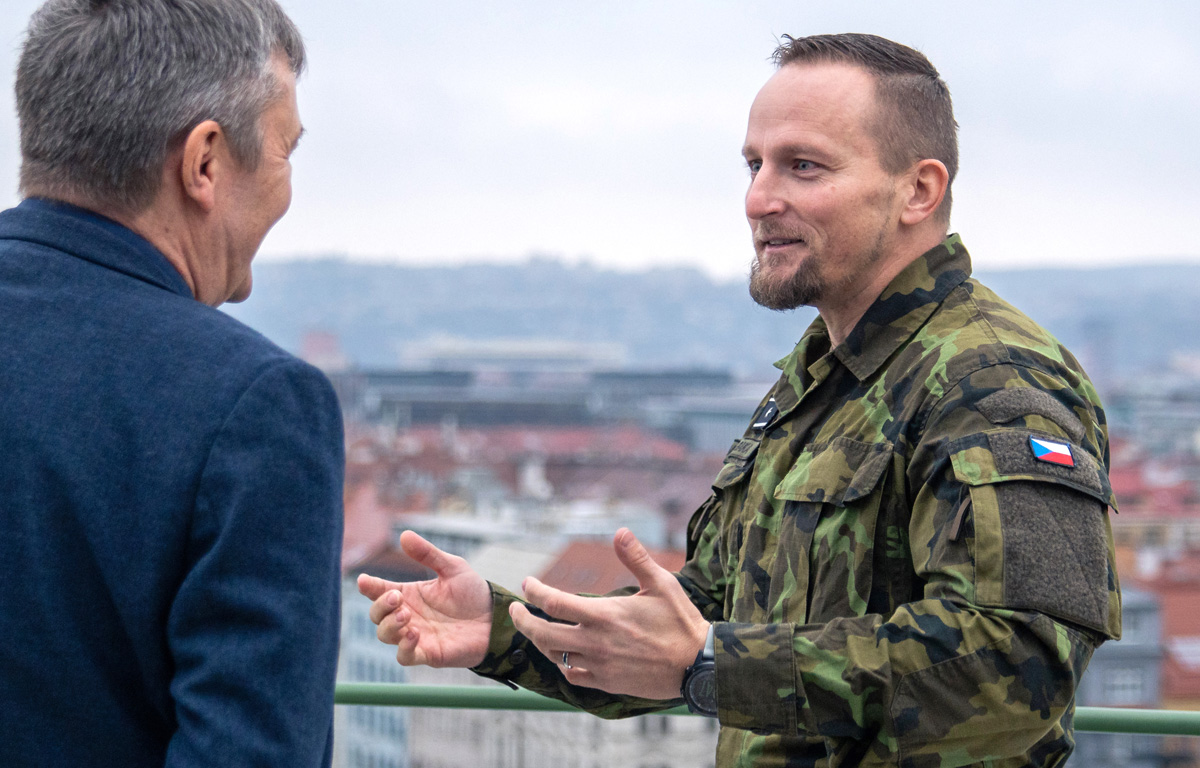
Staff Sergeant Baka sees technological readiness as a generational advantage today. “In 2005, I had a push-button phone and 600 crowns in credit for six months,” he laughs. “Today, you get a tablet, a phone, and a unified workstation. For young people, it’s routine,” says Baka, who also points out that the experience of the “older” generation and the technological ease of the “younger” generation can complement each other: “Young people quickly grasp the menus and controls. Older people, on the other hand, can translate technology into a tactical advantage. This is a good time for progress.”
When asked whether the current trend in the ground forces is toward versatility or specialization, the staff sergeant says both, but with a clear hierarchy. “Each of us in uniform is primarily a fighter,” Baka states, adding that when something happens, a soldier goes out and fights. Specialization is then built on this foundation. “Yes, we need drone operators, C4ISR specialists. Today, every soldier is also a sensor. Real-time data is transmitted, leading to better and more effective fire. Versatility is the backbone, and specialization is necessary to complement it,” explains the Chief Warrant Officer of the ground forces.
If you'd like to learn more, watch the full interview at the beginning of this article.