













Maj. Gen. Jaroslav Míka: DVC Is More About Mental Resilience Than Physical Endurance
Interest in the Voluntary Military Training (DVC) program for high school students has exceeded the expectations of the Czech Army. From the originally planned 800 spots, the army had to increase capacity to 1,060 participants. According to Major General Jaroslav Míka, Deputy Commander of the Czech Army Operations Command, this is not just a recruitment tool, but primarily about building societal resilience and strengthening the reserves in the long term. In an interview with CZ DEFENCE, he discusses the motivation of young people, mental resilience, the limits of training, and why the Czech Republic’s defense capability in the coming years will depend on the ability to prepare society for crisis scenarios.
Video: Maj. Gen. Jaroslav Míka: DVC is more about mental strength than physical exertion / CZ DEFENCE
Just a few years ago, few would have expected the military to face a problem opposite to a shortage of recruits. However, voluntary military training for young people shows that a portion of the upcoming generation is interested in military experience and is willing to step out of their comfort zone. “Last year, we planned to train 525 participants, but in the end we increased capacity to 800. This year, we started with a plan for 800 people, but the interest was so huge that we really had to squeeze every last bit out of the system, and we increased the capacity to 1,060 trainees,” says Major General Jaroslav Míka. He considers this mass participation to be the biggest difference compared to previous years.
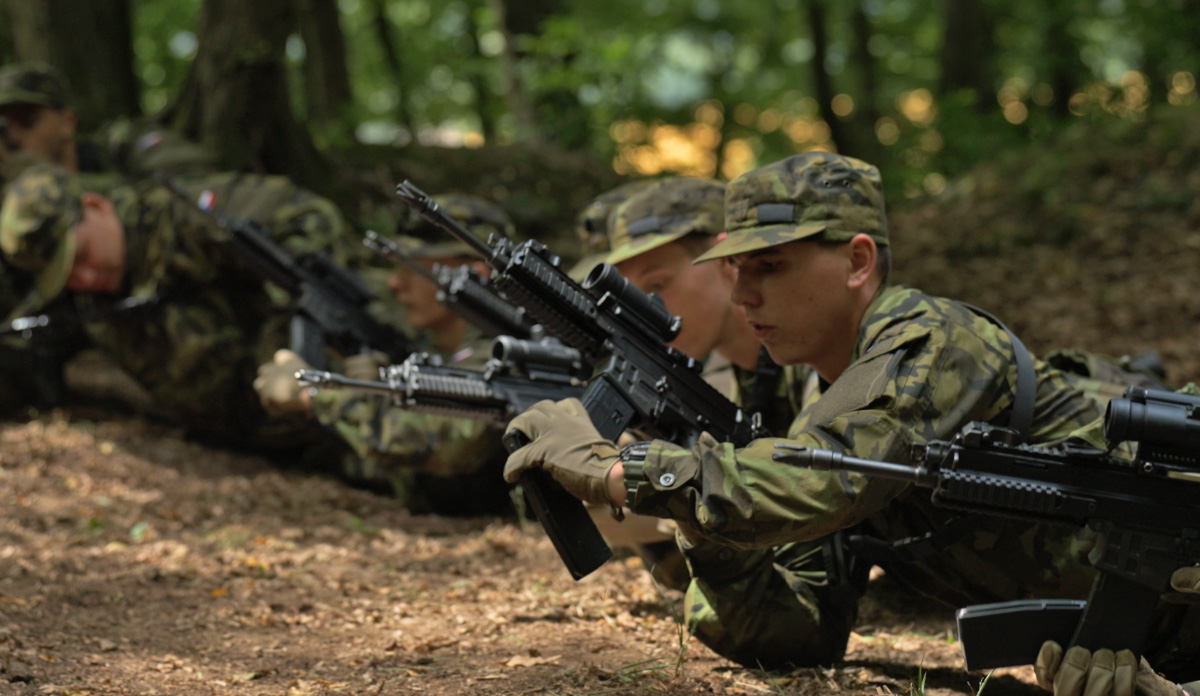
According to him, it’s important to note that this isn’t a traditional voluntary military exercise open to all citizens. The program specifically targets young people aged 18 to 22 – that is, high school graduates or current students. “We’re targeting a group of young people who are just finishing or have already finished high school, so that we can reach that generation. That’s what makes this exercise different from other forms of voluntary military training,” he explains.
There are often debates about whether today’s generation is less resilient than previous ones. Major General Míka rejects such comparisons. “I don’t like those comparisons, because in our parents’ eyes, we were a different generation too,” he says. He does admit, however, that today’s 18-year-olds grew up in a completely different environment. “We were born into the analog era and are trying to find our way in the digital one. Today’s youth were born into a digital world.”
According to him, disconnecting from technology is one of the most significant experiences participants in the voluntary military training take away with them. “They discover that they don’t need to have a cell phone in their hand and that it’s possible to live without one. And based on the feedback, they view this very positively,” he says, describing experiences from previous years. The training isn’t just about physical exertion or learning military routines. In a sense, it is also about confronting reality outside the constant digital environment. Several weeks of an intensive regimen, discipline, and collective responsibility create an experience that many young people have not yet had.
Voluntary military training is also often associated with parental concerns. Part of the public still recalls military service from past decades with all its negative connotations. Major General Míka, however, emphasizes that today’s system operates quite differently. “They can’t imagine the training style from the 1970s or 1980s associated with hazing. It is professional training based on experience and standards that are set not only here but also within the alliance,” he explains. At the same time, he points out that the military does not view the participants as children. “They are not children; they are adults. They are over eighteen years old, and they are the ones who should be receiving the initial information,” he says.
According to him, the training is demanding but professionally led. There are risks, just as with any other physical activity. It’s possible that someone might sprain an ankle or fail to follow safety precautions. But within the normal scope of risks associated with training, we can guarantee maximum prevention,” he adds. One long-term trend is the declining physical fitness of the young population. Major General Míka attributes this development primarily to lifestyle changes. “In our day, house arrest was a punishment. Today, perhaps the punishment would be to send a young person outside,” he remarks with a touch of hyperbole. At the same time, however, he points out that the participants in voluntary military training do not represent a cross-section of the population. “These are people who go there voluntarily and prepare for it in advance. They train physically,” he says.
The military monitors the participants’ physical performance at the beginning and end of the course. According to him, the results show significant improvement. “There has been tremendous progress over the course of four weeks. Young people’s bodies are still very malleable,” he notes. Nevertheless, some participants do not complete the training. Statistics from last year show that out of approximately 715 who enrolled, 636 people completed the course. According to Míka, the reason is surprisingly more often psychological than physical. “Two-thirds of the time, it’s a mental issue. The body can usually handle it, but it comes down to willpower. It’s more about the mind than physical exertion,” he says. Mental resilience thus emerges as one of the most important aspects of modern military training. According to him, voluntary military training is not merely an opportunity to “try out the military.” “You’re making a commitment. You automatically become part of the reserves in case of mobilization,” he notes. In addition to directly recruiting professional soldiers or enlisting in the active reserves, the army thus gains a broader base of prepared citizens. “It’s also a benefit for us when a graduate joins the active reserves,” he adds.
Nevertheless, he does not consider the current model sufficient given future needs. “If we want to build reserves of tens of thousands, then a thousand people a year is a relatively small number,” he points out. According to him, a broader debate is underway regarding systemic changes that could expand the training of the population. At the same time, he highlights another dimension of the project – strengthening the relationship between the army and the regions. “We want the military to be more than just large garrisons; we want local residents to feel a sense of belonging to the units in their region,” he explains.
“However, expanding capacity is hampered by staffing constraints. The ideal ratio is one instructor for every five trainees,” says Major General Míka. Moreover, instructors are not solely dedicated to training reservists. They carry out their own duties and participate in exercises and other military activities. “Our soldiers aren’t machines. They have work hours, vacation time, and family lives,” he points out. That is precisely why he considers long-term capacity increases without changing the system to be unsustainable.
In the interview, we also touch on issues of national defense. Major General Míka points out that the future security environment will place extraordinary demands on logistics in particular. “Logistics wins wars,” he sums up. It is not just about troop movements, but also about supply, infrastructure, the rail network, transport capacity, and the ability to sustain deployed forces over the long term. The Alliance exercise Steadfast Defender, together with the national exercise Resilient Czech Republic 27, is set to be a significant test. “It will test the limits of the transport infrastructure as well as society’s ability to support its own defense,” he notes. Active reserves will also be involved in the scenarios.
Back to DVC. The answer to the question of what will constitute success for this year’s edition is surprisingly simple. “We’ll be happy if those who get into the exercise actually show up. If someone doesn’t come, they’re taking a spot from someone else who wanted it,” says Míka. Equally important, he says, is for participants to push past their own limits. “So they grit their teeth and get through it,” he concludes.
Experience from previous years shows that feedback reached up to 95 percent positive ratings. And that may be the most compelling evidence that voluntary military training is gradually becoming not only a tool for preparing reserves but also a way to build a more resilient society for a time that will be significantly more challenging in terms of security than the period to which Europe has become accustomed in recent decades.
If you’d like to learn more, watch the full video interview at the beginning of this article.