















Front line without people? The risk of over-reliance on unmanned systems
With the rapid acceleration of the development and deployment of unmanned systems—whether ground, air, or sea—on the Ukrainian battlefield, narratives have begun to emerge in Western discourse that question the importance of building ground forces in terms of their size. This narrative argues that there is no need for a larger number of manned combat units, as the enemy can be destroyed using unmanned systems, which will also be able to guard the line of contact with the enemy. Although drones (as has been mentioned many times) are an important part of the current battlefield and offer advantages in terms of strikes, reconnaissance, communication, and logistics, the Ukrainian experience clearly shows that without sufficient combat units, especially infantry, it is not possible to wage a successful war—not even a defensive one.
Limits of long-range combat
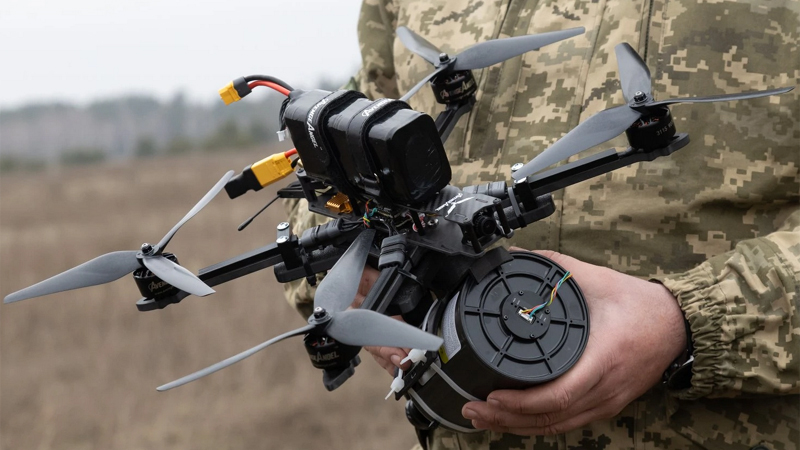
Although unmanned aerial vehicles cause a significant portion of the losses in equipment and manpower of the enemy, they assist with supply, reconnaissance, and guidance of traditional indirect fire support, yet it is the infantry that holds the line of contact between Ukrainian and Russian forces. And it is the infantry, supported by armored vehicles, that conquers and defends the territory.
Despite the levelling of the fundamental imbalance in the number of artillery shells (largely thanks to the so-called Czech ammunition initiative) and the intensive use of drones on the Ukrainian side, Russian forces are slowly advancing. Reports from Ukrainian soldiers are clear: the main reason is a lack of troops—people, infantry—to hold the front line against Russian attacks, and the absence of sufficient reserve units to allow for more frequent rotations of deployed forces (which greatly helps morale). This situation clearly demonstrates that unmanned aerial vehicles are not omnipotent. And this is no surprise – counter-weapon systems are being developed against them, they are limited by weather (fog, wind, rain), environment (forests, urban areas), and with the Russian onslaught, the smaller number of Ukrainian troops cannot always hold the front line, even with the support of drones. Fighting continues in trenches, buildings, and woodlands, between ground forces, and occasionally there are clashes involving armored vehicles. Drones with limited reliability are no substitute for a unit that can gain and defend territory in direct combat—just as a drone is unable to perform certain types of reconnaissance (such as gathering information directly from the field or HUMINT—human intelligence). It is therefore a significant aid, not a replacement.
Man hand in hand with technology
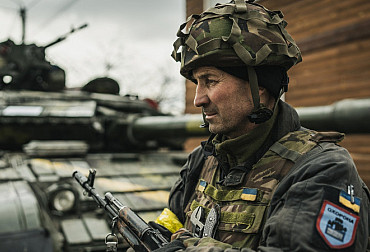
The conclusion seems clear and is supported by Ukraine's experience. This is also confirmed by further steps taken by some countries in the European part of the North Atlantic Alliance. Germany, Lithuania, Poland, and other countries are working on new models of military service and building trained personnel reserves so that they can quickly expand and replenish their forces in the worst-case scenario.
Artificial intelligence and unmanned vehicles must, of course, continue to be developed intensively—in many cases, they can save human lives. An example is analytical AI, which helps process huge amounts of data, thereby relieving staff and commanders and speeding up the decision-making process. Or partially autonomous unmanned logistics and reconnaissance systems that save human resources. Similarly, cheaper precision weapons that "wear down" the enemy's forces and make it easier for soldiers to fight in defense and attack.
Nevertheless, two things must be kept in mind. First, as mentioned above, this is primarily a force multiplier—that is, it multiplies and strengthens existing capabilities rather than replacing them. Second, a larger number of more sophisticated unmanned vehicles will also mean higher demands on service, maintenance, and system security – and this will again require qualified human personnel.
It is therefore necessary to build up traditional units, including infantry and manned systems, and only then significantly increase their overall potential with the help of AI and unmanned vehicles, which increase combat value and reduce casualties. Only in this way can a truly credible deterrent potential be built. Because the best weapons are those that do not have to be used.